
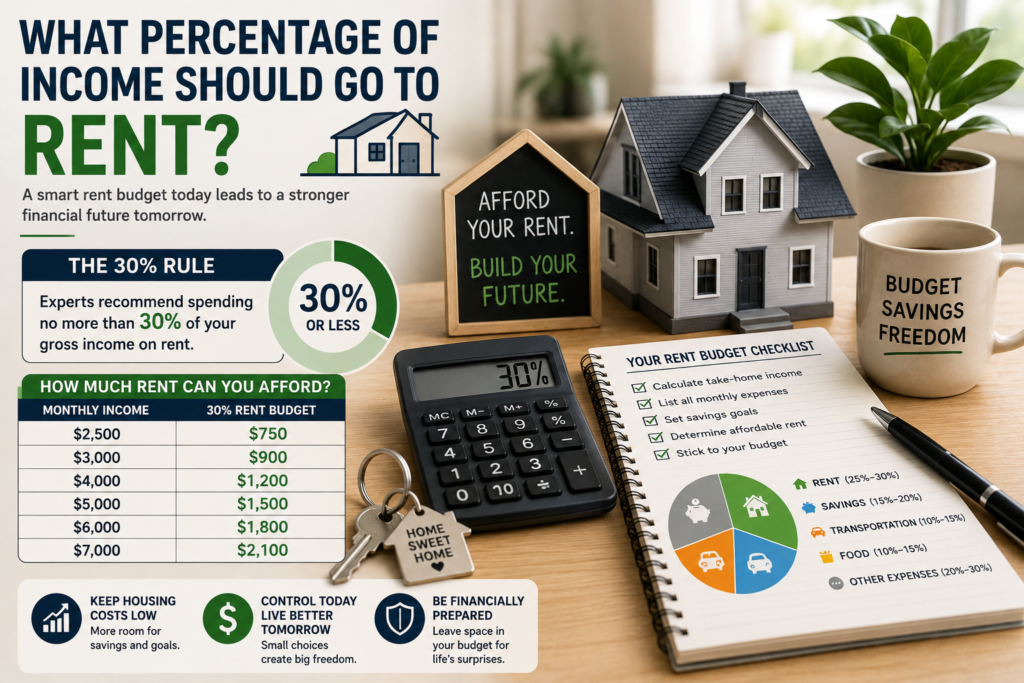
Rent is often the largest monthly expense in a household budget. Whether you earn $3,000, $4,000, $5,000, or more each month, choosing the right rent can make the difference between feeling financially comfortable and constantly struggling to make ends meet.
So, what percentage of income should go to rent?
A commonly recommended target is no more than 30% of your gross monthly income. However, that number isn’t a universal rule. Your debt, location, income stability, savings goals, and other expenses all influence how much rent you can realistically afford.
Here’s how to determine your ideal rent budget.
The 30% Rule for Rent
The most commonly cited guideline says that housing costs should consume no more than 30% of your gross income.
For example:
| Monthly Income | 30% Rent Budget |
|---|---|
| $2,500 | $750 |
| $3,000 | $900 |
| $4,000 | $1,200 |
| $5,000 | $1,500 |
| $6,000 | $1,800 |
| $7,000 | $2,100 |
If you earn $4,000 per month, the 30% rule suggests keeping rent around $1,200 or less.
But there’s an important distinction: this is a guideline, not a guarantee that $1,200 is affordable for you.
If you have significant student loans, credit card payments, childcare costs, or expensive transportation, even $1,200 could put pressure on your budget.
Should You Calculate Rent From Gross or Net Income?
This is where many renters get confused.
The traditional 30% rule is based on gross income, meaning your income before taxes and payroll deductions.
However, your actual spending decisions are made with your take-home pay.
Suppose you earn $4,000 per month before taxes but take home $3,200.
A $1,200 rent payment represents:
30% of gross income
but:
37.5% of take-home income
That’s a significant difference.
For a more conservative budget, consider calculating your housing costs against your net income as well. If rent consumes too much of your take-home pay, you may have difficulty covering food, transportation, savings, debt payments, and unexpected expenses.
What Percentage of Income Should Go to Rent?
For many households, a practical range looks like this:
Under 25%: Excellent
Spending less than 25% of income on rent gives you substantial financial flexibility.
You have more room for:
- Emergency savings
- Retirement contributions
- Investing
- Debt repayment
- Travel and entertainment
- Unexpected expenses
If you can maintain a comfortable lifestyle while keeping rent below 25%, you’re in a strong position.
25%–30%: Healthy
This is often a comfortable range for renters with relatively manageable debt and stable income.
At this level, housing remains a significant expense without consuming most of your monthly budget.
30%–35%: Manageable but Requires Planning
Once rent moves above 30%, you need to look carefully at the rest of your finances.
A higher percentage may still be reasonable if you have:
- Very little debt
- Low transportation costs
- Strong income stability
- Significant savings
- Few other major expenses
Over 35%: Financially Risky
When rent exceeds 35% of income, your budget can become increasingly fragile.
A rent payment of $1,500 may look manageable on a $4,000 salary, but after utilities, groceries, transportation, insurance, and debt payments, there may be very little left for savings.
Don’t Forget the Total Cost of Housing
Rent isn’t always your entire housing expense.
Before deciding how much rent you can afford, consider:
- Utilities
- Internet
- Renter’s insurance
- Parking
- Application fees
- Pet fees
- Maintenance-related expenses
- Transportation costs associated with the location
A $1,100 apartment with $250 in additional monthly costs can effectively cost you $1,350 per month.
That’s why comparing apartments based solely on advertised rent can lead to an inaccurate budget.
Your Debt Can Change the Equation
Two people earning the same salary may have completely different affordable-rent limits.
Imagine two people each earn $4,000 per month.
Person A has no debt and spends $1,000 on rent.
Person B has $700 in monthly student loan and credit card payments and also spends $1,000 on rent.
The same rent is much more expensive relative to Person B’s overall financial situation.
If you have substantial debt, keeping rent below 30% may be especially important because it gives you more money to attack high-interest balances.
How Rent Affects Your Ability to Save
Housing costs don’t just affect your current lifestyle. They can also determine how quickly you build wealth.
Consider someone earning $4,000 per month who spends:
$1,200 on rent
versus someone who spends:
$900 on rent
The second person has an additional $300 per month, or $3,600 per year, available for saving or investing.
Over several years, that difference can become substantial.
Lower rent doesn’t necessarily mean sacrificing quality of life. Sometimes choosing a slightly smaller apartment, living with a roommate, or moving to a less expensive neighborhood can significantly improve your long-term financial position.
What If Rent Is Expensive in Your City?
The 30% rule becomes harder to follow in expensive housing markets.
If local apartments are significantly more expensive than the traditional guideline suggests, you may need to make trade-offs.
Possible strategies include:
- Getting a roommate
- Choosing a smaller apartment
- Living farther from the city center
- Negotiating rent
- Finding an apartment with utilities included
- Increasing your income
- Reducing other fixed expenses
The important thing is to look at your entire budget, not just whether you technically qualify for an apartment.
A landlord may approve your application for a rent payment that leaves you financially stretched. Approval does not equal affordability.
A Better Way to Determine Your Rent Budget
Instead of blindly following the 30% rule, use this simple process.
Step 1: Calculate Your Monthly Take-Home Income
Start with the amount that actually reaches your bank account after taxes and payroll deductions.
Step 2: List All Fixed Expenses
Include debt payments, insurance, transportation, subscriptions, and other recurring bills.
Step 3: Estimate Variable Expenses
Account for groceries, entertainment, clothing, personal expenses, and other spending that changes from month to month.
Step 4: Set Your Savings Target
Treat savings as a planned expense rather than simply saving whatever happens to be left over at the end of the month.
Step 5: Determine Your Affordable Rent
After accounting for your essential expenses and savings goals, determine how much you can comfortably allocate toward housing.
This approach gives you a much more realistic number than simply multiplying your gross salary by 30%.
The Bottom Line
So, what percentage of income should go to rent?
For most renters, keeping rent around 25%–30% of gross income is a reasonable target. Spending less than 25% can provide even greater financial flexibility, while going above 30% requires careful budgeting.
The most important thing is not finding the maximum rent a landlord will approve. It’s finding a rent payment that allows you to live comfortably, save consistently, pay your debts, and handle unexpected expenses.
Your apartment is part of your lifestyle, but it shouldn’t consume your financial future.
The best rent is not the most expensive home you can afford. It’s the home that fits comfortably within the life you want to build. Click in Read Next: