
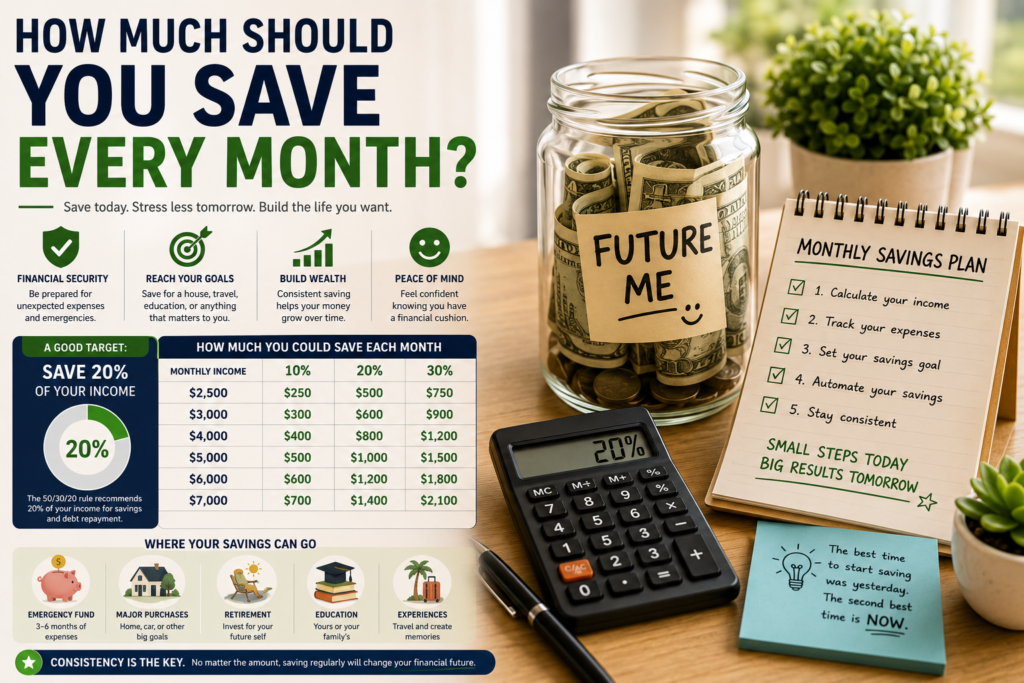
Saving money every month is one of the simplest ways to build financial security, reduce stress, and prepare for the future. But one question comes up again and again: How much should you save every month?
There is no single number that works for everyone. Your ideal monthly savings amount depends on your income, expenses, debt, financial goals, and lifestyle. However, using a few proven guidelines can help you determine a realistic savings target and create a plan you can actually maintain.
How Much Should You Save Each Month?
A common starting point is to save 20% of your monthly income. This percentage is often associated with the popular 50/30/20 budgeting framework, where 50% goes toward needs, 30% toward wants, and 20% toward savings and debt repayment.
For example:
| Monthly Income | 10% Savings | 20% Savings | 30% Savings |
|---|---|---|---|
| $2,500 | $250 | $500 | $750 |
| $3,000 | $300 | $600 | $900 |
| $4,000 | $400 | $800 | $1,200 |
| $5,000 | $500 | $1,000 | $1,500 |
| $6,000 | $600 | $1,200 | $1,800 |
| $7,000 | $700 | $1,400 | $2,100 |
If saving 20% is currently unrealistic, don’t assume you are failing. Starting with 5% or 10% and increasing the percentage over time can still make a significant difference.
Is Saving 10% of Your Income Enough?
For some people, saving 10% of income every month is an excellent starting point. It is particularly useful if you are dealing with high living costs, student loans, credit card debt, or a lower income.
For example, someone earning $4,000 per month who saves 10% would put away $400 every month, or $4,800 per year.
The important thing is consistency. A sustainable savings habit is generally more valuable than setting an aggressive target that forces you to abandon your plan after a few months.
Once your financial situation improves, you can gradually increase your savings rate from 10% to 15%, 20%, or even higher.
When Should You Save 20% or More?
Saving 20% of your income becomes especially valuable when you want to build wealth, purchase a home, retire early, or reach another major financial goal.
If you earn $5,000 per month and save 20%, you would save $1,000 each month. That equals $12,000 per year, before considering any investment growth.
People with lower housing costs, fewer debts, or higher incomes may be able to save 25% or 30% of their income. A higher savings rate can significantly shorten the time required to reach major financial goals.
The key is not simply earning more—it is keeping your expenses from increasing at the same rate as your income.
Build an Emergency Fund First
Before focusing heavily on long-term investing, consider building an emergency fund.
An emergency fund can help cover unexpected expenses such as car repairs, medical bills, home repairs, or temporary income loss without forcing you to rely on credit cards or loans.
A common target is three to six months of essential living expenses.
For example, if your necessary monthly expenses are $2,500, an emergency fund of $7,500 to $15,000 could provide a meaningful financial cushion.
If you are starting from zero, don’t worry about reaching the full amount immediately. Focus on building the fund one monthly contribution at a time.
Your Savings Rate Matters More Than a Specific Dollar Amount
One mistake people make is comparing their savings with someone else’s dollar amount.
Someone earning $3,000 per month may save $500, while another person earning $8,000 may save $1,000. Although the second person saves more money in absolute terms, the first person is saving a larger percentage of income.
That is why your savings rate is often a better measurement than the dollar amount alone.
A person earning $4,000 per month and saving $800 has a 20% savings rate. If their income increases to $5,000 and they continue saving $800, their savings rate falls to 16%.
When your income increases, consider increasing your monthly savings contribution as well.
How Much Should You Save for Retirement?
Retirement savings should be part of your long-term financial plan. The amount you need depends on your age, expected retirement lifestyle, current savings, investment returns, and desired retirement age.
Rather than waiting until you can make large contributions, start with an amount that fits your budget and increase it gradually.
For example, you could begin by contributing 10% of your income and increase your contribution whenever you receive a raise, bonus, or additional income.
The advantage of starting early is that your savings have more time to potentially benefit from compound growth.
How to Increase Your Monthly Savings
If you are struggling to save money every month, look for ways to increase the gap between your income and expenses.
Start by reviewing your largest spending categories, such as:
- Housing
- Transportation
- Groceries
- Insurance
- Debt payments
- Subscriptions
- Entertainment
Cutting a few recurring expenses can create additional money for savings without dramatically changing your lifestyle.
Another effective strategy is automating your savings. Set up an automatic transfer from your checking account to a dedicated savings or investment account shortly after receiving your paycheck.
When saving happens automatically, you are less likely to spend the money first.
What If You Cannot Save 20%?
If 20% seems impossible right now, start smaller.
Saving $100 every month is better than saving nothing. Saving $200 is better than $100. The goal is to create a habit that can grow as your financial situation improves.
You can also use a gradual approach:
Start at 5% → increase to 10% → reach 15% → work toward 20% or more.
This approach makes saving feel manageable while allowing your financial habits to improve over time.
The Bottom Line
So, how much should you save every month? For many people, 20% of income is a strong long-term target, but it is not a requirement.
If you can currently save only 5% or 10%, start there. If your income and expenses allow you to save 20%, 25%, or 30%, take advantage of that opportunity.
The most important factors are consistency, a clear financial goal, and increasing your savings rate as your income grows.
Whether you are building an emergency fund, saving for a home, preparing for retirement, or simply trying to become financially independent, every monthly contribution moves you closer to your goal. Click in Read Next: