Earning $5,000 a month can provide significantly more financial flexibility than earning a lower income, but that does not automatically guarantee financial security. Without a clear plan, higher earnings can quickly disappear into higher housing costs, expensive cars, dining out, subscriptions, travel, and lifestyle upgrades.
The key to making a $5,000 monthly income work for you is to create a budget that balances your current needs with your long-term financial goals. With the right strategy, you can pay your bills, enjoy your money, reduce debt, build an emergency fund, and invest for the future.
Start With Your Take-Home Pay
The first step is to determine whether your $5,000 figure represents your gross income or your actual take-home pay.
If you earn $5,000 before taxes, your available spending money will be lower after federal, state, and local taxes, insurance premiums, retirement contributions, and other deductions.
For budgeting purposes, always use the amount that actually reaches your bank account.
If you bring home $5,000 per month after taxes and deductions, you have $60,000 available annually for your household budget.
If your income varies, consider creating your basic budget around your lowest expected monthly income. When you earn more than expected, the additional money can be directed toward savings, investments, or debt repayment.
Consider the 50/30/20 Budget
A useful starting point for a $5,000 monthly income is the 50/30/20 budgeting framework.
Under this approach, approximately 50% goes toward needs, 30% toward wants, and 20% toward savings and debt repayment.
That would give you:
| Category | Percentage | Monthly Amount |
|---|---|---|
| Needs | 50% | $2,500 |
| Wants | 30% | $1,500 |
| Savings/Debt | 20% | $1,000 |
| Total | 100% | $5,000 |
These percentages are not strict requirements. Your circumstances may require a different allocation.
For example, someone living in a high-cost city may spend more than 50% on housing and essential expenses. Someone with minimal debt and low housing costs may be able to save 25% or even 30%.
The purpose of a budgeting framework is to provide direction, not to create unnecessary restrictions.
Keep Housing Costs Under Control
Housing is usually the largest expense in a household budget, which makes it one of the most important categories to manage.
With $5,000 in monthly take-home income, spending around $1,500 on rent or a mortgage could leave substantial room for other financial priorities. However, your ideal housing budget depends on your location, family size, debts, and other obligations.
Avoid choosing a home based solely on what a lender says you can afford. A larger mortgage or more expensive apartment may leave you with less money for retirement, emergencies, travel, and other goals.
Keeping housing costs reasonable can create thousands of dollars in additional financial flexibility every year.
Plan for Food and Everyday Expenses
Food is another category that can quietly become expensive.
A household earning $5,000 per month might spend $400 to $700 or more on groceries and restaurants, depending on family size and lifestyle.
Meal planning, preparing food at home, buying store brands, shopping with a list, and reducing food waste can help control costs.
The goal is not to eliminate restaurants or enjoyable meals. Instead, establish a monthly amount for dining and entertainment and treat it as part of your planned spending.
When you know exactly how much you can spend, you can enjoy those purchases without constantly worrying about whether they will damage your finances.
Don’t Let Lifestyle Inflation Consume Your Raise
One of the biggest advantages of earning $5,000 rather than $3,000 per month is having more room to save.
However, that advantage disappears if your lifestyle expands just as quickly as your income.
Lifestyle inflation occurs when people earn more and immediately increase their spending. A higher salary may lead to a more expensive apartment, a larger car payment, more frequent vacations, and higher everyday expenses.
Instead, consider using part of every income increase to strengthen your finances.
For example, if your income increases by $500 per month, you might invest $300 and use $200 to improve your lifestyle.
This approach allows you to enjoy earning more without sacrificing your long-term goals.
Build an Emergency Fund
An emergency fund should be a major priority even if you have a relatively comfortable income.
Unexpected expenses can happen at any time. A major car repair, medical bill, temporary job loss, or urgent home expense can create financial stress if you have no cash reserves.
Start with a small target such as $1,000. After that, gradually work toward saving enough to cover several months of essential expenses.
If you save $500 per month, you could build a $6,000 emergency fund in one year, assuming you don’t need to withdraw from it.
Keep emergency savings in an accessible account rather than investing money you may need immediately.
Pay Down High-Interest Debt
If you have credit card balances or other high-interest debt, eliminating that debt can be one of the most effective uses of your extra cash flow.
You can use either the debt avalanche method or the debt snowball method.
The avalanche strategy focuses on paying the debt with the highest interest rate first. The snowball strategy focuses on the smallest balance first, which can provide a psychological boost as accounts are eliminated.
Whichever method you choose, continue making at least the minimum payment on every account.
Once a debt is paid off, redirect the money that was going toward that payment into savings or investments.
Make Retirement Savings Automatic
Once your emergency fund and high-interest debt are under control, increasing retirement contributions should become a major goal.
If you earn $5,000 per month and invest 20%, that represents $1,000 per month or $12,000 per year.
If your employer offers a retirement plan with matching contributions, taking advantage of the available match can be particularly valuable.
You can also consider other tax-advantaged retirement accounts depending on your circumstances and eligibility.
The most important factor is consistency. Investing a manageable amount every month can be more effective than trying to make occasional large contributions.
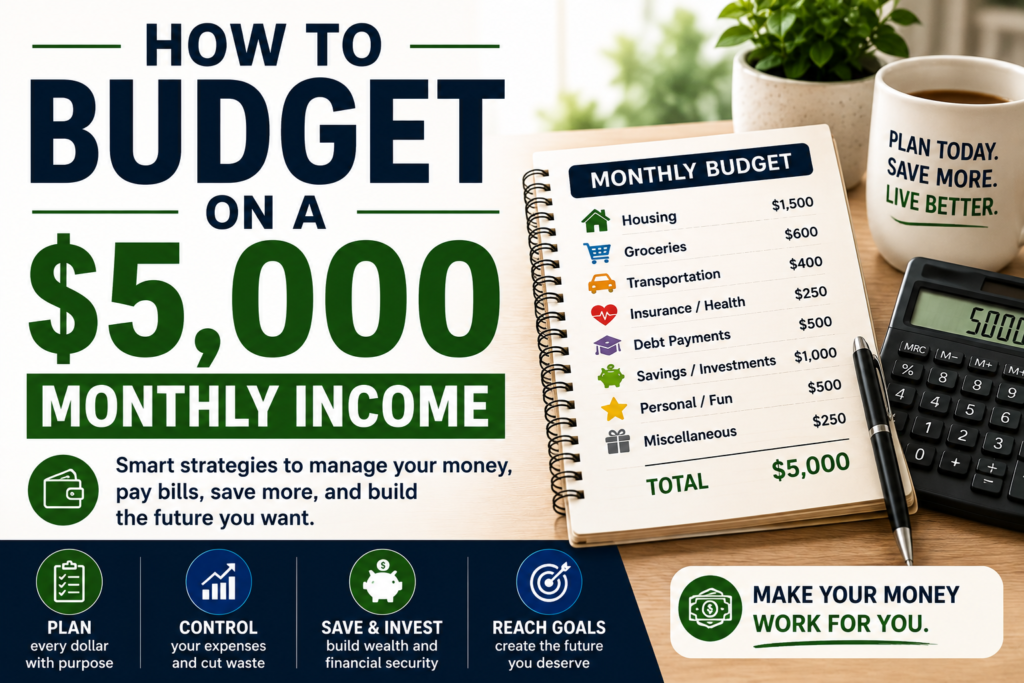
Example of a $5,000 Monthly Budget
A possible budget could look like this:
- Housing and utilities: $1,500
- Groceries: $500
- Transportation: $400
- Insurance and healthcare: $250
- Debt payments: $350
- Retirement and savings: $1,000
- Entertainment and dining: $400
- Personal expenses: $250
- Miscellaneous: $350
Total: $5,000
This is only an example. Your actual budget should reflect your household, location, debt obligations, and personal priorities.
The Bottom Line
A $5,000 monthly income can provide a strong foundation for financial stability, but the amount you earn is only part of the equation.
The real opportunity comes from controlling your expenses while increasing your savings and investments. Keep housing and transportation costs reasonable, plan your discretionary spending, build an emergency fund, eliminate expensive debt, and automate your savings.
Most importantly, avoid allowing lifestyle inflation to consume every additional dollar you earn.
If you can consistently maintain a meaningful gap between your income and expenses, that gap can become the foundation for long-term wealth.
A $5,000 monthly income gives you an opportunity to do more than simply pay the bills. With a thoughtful budget, it can help you save for emergencies, eliminate debt, invest for retirement, and create greater financial freedom over time.
Check out our full $6,000 budget guide here👈