
Living on a $3,000 monthly income ($36,000 annually) requires deliberate choices, but it is entirely possible to build stability, cover essentials, and enjoy life without earning a six-figure salary. The secret isn’t restrictive deprivation; it’s about giving every dollar a deliberate job and creating a framework that fits your actual life.
Step 1: Establish Your True Baseline (Take-Home Pay)
Before assigning dollars to categories, lock down your exact monthly net income—the cash that actually hits your bank account after taxes, health insurance premiums, and retirement deductions.
- For Steady Earners: Use your verified net monthly income as your absolute ceiling.
- For Variable or Freelance Earners: Base your budget on your lowest expected monthly income. Treat any surplus during high-earning months as bonus funding for your emergency fund or debt payoff.
Knowing your precise baseline prevents you from budgeting money you don’t actually have.
Step 2: Use the 50/30/20 Rule as a Compass, Not a Law
The 50/30/20 framework is a popular starting point for dividing after-tax income, but it should bend to fit your reality rather than breaking your budget:
| Category | Recommended % | Monthly Dollar Allocation | What It Covers |
|---|---|---|---|
| Needs | 50% | $1,500 | Rent, utilities, groceries, basic transport, insurance, minimum debt payments |
| Wants | 30% | $900 | Dining out, hobbies, entertainment, subscriptions, shopping |
| Savings & Debt | 20% | $600 | Emergency fund, extra debt principal payments, long-term investments |
Note: If you live in a high-cost-of-living area, your “Needs” might easily creep past 50%. If that happens, trim from your “Wants” category rather than stressing over a rigid formula.
Step 3: Tackle the Heavy Hitters (Housing & Transport)
Small lifestyle cuts—like skipping a daily coffee—pale in comparison to optimizing your fixed, recurring expenses.
- Optimize Housing: Housing is usually your biggest single expense. If you take home $3,000, aiming for rent under $1,000 leaves you with massive breathing room. If rent is already high, look at long-term solutions: securing a roommate, negotiating a lease renewal, or planning a move to a more affordable neighborhood when your lease ends. A $200 monthly drop in rent equals $2,400 back in your pocket every year.
- Audit Total Transportation: Don’t judge a car solely by its monthly loan payment. Factor in insurance, fuel, parking, and regular maintenance. Utilizing public transit, carpooling, or swapping a gas-guzzling vehicle for an efficient commuter car can free up hundreds of dollars each month.
Step 4: Streamline Food and Discretionary Spending
Food is one of the easiest areas to accidentally overspend, but it’s also highly controllable.
- Plan Before You Shop: Review your last two months of bank statements to find your actual baseline food spend. Instead of setting an impossibly low grocery budget, aim to trim 15% to 20% by meal-planning, utilizing store brands, and packing lunches. Shifting from a $600 combined grocery and restaurant habit down to $450 saves you $1,800 annually.
- Build in Fun Guilt-Free: A budget that cuts out all joy is doomed to fail. Designate $150 to $200 strictly for entertainment, hobbies, or dining out. When you give yourself a dedicated allowance, you can spend it completely guilt-free without sabotaging your core goals.
Step 5: Protect Your Future (Savings and Debt Strategy)
- Build a Starter Emergency Fund: Unexpected expenses will happen—whether it’s a dental bill or car trouble. Prioritize saving a small initial buffer ($500 to $1,000), then scale it up over time until you have 3 to 6 months of essential expenses tucked away. Saving just $100 a month yields $1,200 in a year.
- Conquer High-Interest Debt: Credit cards and personal loans drain your monthly cash flow through interest. Use the debt avalanche method (tackling the highest interest rate first) or the debt snowball method (wiping out the smallest balance first for psychological wins) to clear them out. Once a debt is gone, roll that exact payment amount directly into your savings.
- Automate Your Success: Don’t rely on willpower at the end of the month. Set up an automatic transfer to move your savings ($300 to $500) into a separate account the day after you get paid.
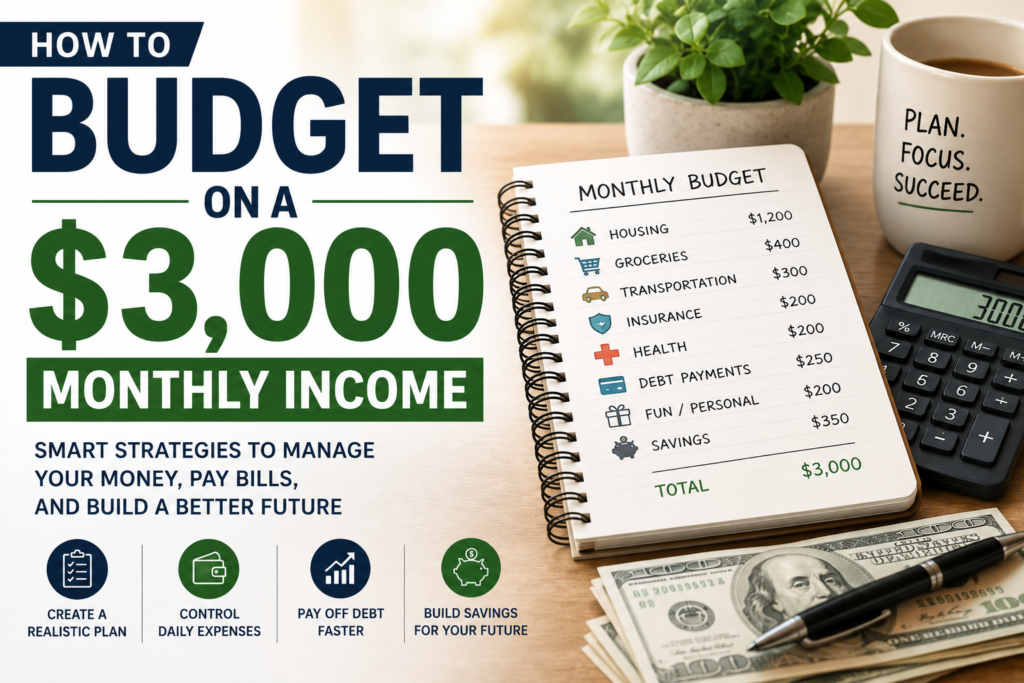
Sample Monthly Budget Breakdown ($3,000 Net Income)
Every individual’s situation is unique, but a healthy, balanced allocation for a $3,000 monthly income often looks similar to this:
- Rent and Utilities: $1,100
- Groceries and Household Supplies: $350
- Transportation (Gas, Transit, Insurance): $300
- Insurance and Healthcare: $150
- Debt Payments (Beyond Minimums): $200
- Savings & Emergency Fund: $350
- Personal Spending & Entertainment: $200
- Miscellaneous / Buffer: $150
- Total: $3,000
Final Thoughts
Managing a $3,000 monthly income successfully isn’t about constant restriction; it’s about intentional alignment. By focusing heavily on your fixed costs, protecting your cash flow with an emergency fund, and automating your savings, you build a resilient financial foundation.
As your income grows over time, avoid lifestyle inflation—the habit of spending every extra dollar you earn. Instead, direct a portion of every raise toward your future, and watch your financial security compound.