Making $6,000 a month should put you in a strong financial position. But if you still feel broke at the end of every month, the problem probably isn’t your income. It’s your system.
A $6,000 monthly income can provide plenty of room for housing, food, transportation, entertainment, savings, and investing.
But there’s a catch.
The more you earn, the easier it becomes to spend more without realizing it.
A nicer apartment becomes “necessary.” A newer car becomes “affordable.” Restaurant meals become routine. Subscriptions multiply. Weekend trips stop feeling like luxuries.
Then you look at your bank account and wonder where the money went.
If you bring home $6,000 per month, you don’t need a complicated financial strategy. You need a budget that gives your money a purpose before you spend it.
What Is a Good Budget for a $6,000 Monthly Income?
There isn’t one perfect budget for everyone earning $6,000 a month.
Your ideal budget depends on where you live, whether you have children, your debt, transportation costs, health expenses, and your financial goals.
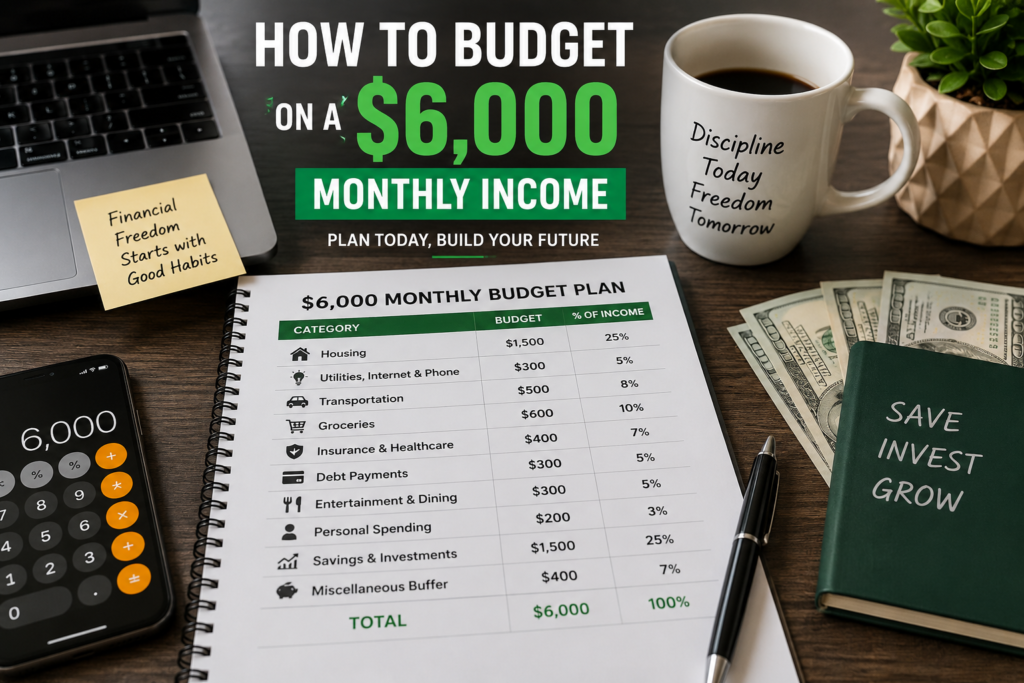
However, here’s a realistic example of how you could allocate a $6,000 take-home income:
| Category | Monthly Amount |
|---|---|
| Housing | $1,500 |
| Utilities, Internet & Phone | $300 |
| Transportation | $500 |
| Groceries | $600 |
| Insurance & Healthcare | $400 |
| Debt Payments | $300 |
| Entertainment & Dining | $300 |
| Personal Spending | $200 |
| Savings & Investments | $1,500 |
| Miscellaneous Buffer | $400 |
| Total | $6,000 |
This isn’t a rule. It’s a starting point.
The goal is to create enough margin that you can pay your bills, handle unexpected expenses, and still make meaningful progress toward financial independence.
How Much Should You Save If You Make $6,000 a Month?
If you can save and invest $1,500 per month, that’s 25% of a $6,000 take-home income.
That means you’re not simply earning money. You’re converting part of your income into future financial security.
You could divide that money between an emergency fund, retirement accounts, investments, and short-term goals depending on your situation.
But don’t get trapped by a specific percentage.
Someone with $50,000 in high-interest debt has different priorities from someone with no debt and $100,000 in savings.
The best savings rate is the one that is aggressive enough to move you forward without forcing you to abandon the budget after two months.
Consistency beats financial perfection.
Keep Housing Under Control
If you’re serious about budgeting on a $6,000 monthly income, start with housing.
Not coffee. Not Netflix. Not coupons. Housing.
A $100 monthly reduction in groceries saves $1,200 a year. A $500 reduction in housing saves $6,000 a year.
That’s why major fixed expenses deserve more attention than small discretionary purchases.
A $1,500 housing budget on $6,000 of take-home income represents 25% of your income. If your housing costs are $2,500, you’re spending more than 40% before paying for food, transportation, insurance, or anything else.
You may still be able to afford it. But affordability isn’t the same as financial efficiency.
Your biggest recurring expenses deserve your biggest scrutiny.
Don’t Let a $6,000 Income Become a $6,000 Lifestyle
This is the financial trap nobody talks about enough.
You don’t necessarily become financially secure when your income rises. Sometimes you simply become better at spending.
You get a raise and immediately upgrade your lifestyle. Then another raise comes along. You upgrade again.
Eventually, your income is much higher than before, but your financial stress hasn’t changed.
This is called lifestyle inflation, and it can quietly destroy the advantage of a higher income.
Instead, when your income increases, consider sending a meaningful portion of the increase directly toward savings and investments.
Make your wealth grow faster than your lifestyle.
Build an Emergency Fund
A budget without an emergency fund is fragile.
Your car will eventually need repairs. Your appliances will eventually break. Bills will eventually arrive at inconvenient times. And sometimes life simply goes wrong.
That’s why you need cash reserves for unexpected expenses.
A common target is three to six months of essential expenses, although the appropriate amount depends on your employment stability, household situation, debt, and risk level.
If your essential expenses are $3,000 per month, six months would mean $18,000.
That may sound like a huge number. But financial security is supposed to take time.
The goal isn’t to build the entire emergency fund overnight. The goal is to build it consistently until one bad month doesn’t become a financial disaster.
Create Sinking Funds for Expenses You Know Are Coming
Here’s a budgeting mistake that makes people feel like they’re constantly dealing with emergencies:
They treat predictable expenses as unexpected expenses.
- Your annual insurance payment isn’t an emergency.
- Christmas isn’t an emergency.
- Car maintenance isn’t an emergency.
- A yearly vacation isn’t an emergency.
You simply didn’t set aside money for them.
Instead of waiting for these expenses to destroy your monthly budget, create sinking funds.
For example, if you expect to spend $1,200 on car maintenance and repairs over a year, setting aside $100 per month gives you $1,200 when you need it.
Small monthly contributions can turn large expenses into manageable ones.
Track Every Dollar for 30 Days
You don’t have to track every penny for the rest of your life. But do it for 30 days.
Record your rent, your groceries, your delivery orders, your subscriptions, your online shopping, your gas, your weekend spending. Everything.
Then look at the numbers without making excuses.
You might discover that the problem isn’t one enormous expense. It’s dozens of small decisions repeated every week.
That’s where budgeting becomes powerful. You can’t control what you refuse to measure.
What If You Have Debt?
If you’re carrying high-interest debt, your budget needs to reflect that reality.
A $6,000 income can look impressive on paper while a large credit-card balance quietly destroys your financial progress.
After covering essential expenses and maintaining an appropriate emergency cushion, aggressively attacking high-interest debt can be one of your highest financial priorities.
Don’t obsess over investing while simultaneously paying extremely high interest on consumer debt. The math matters more than the excitement.
The Best $6,000 Budget Gives You Freedom
The purpose of budgeting isn’t to make your life miserable.
It’s not about refusing every restaurant meal, canceling every vacation, or feeling guilty whenever you buy something you enjoy. That’s not financial freedom.
The purpose of a budget is to make sure your spending reflects your priorities.
- If travel matters to you, budget for travel.
- If buying a home matters to you, save for it.
- If early retirement matters to you, invest aggressively.
- If spending more time with your family matters to you, build your finances around that goal.
Money is most powerful when it gives you choices.
A $6,000 monthly income gives you an opportunity. But opportunity isn’t the same thing as wealth.
You can earn $6,000 every month and still live paycheck to paycheck.
Or you can earn $6,000, control your fixed expenses, avoid lifestyle inflation, eliminate expensive debt, build an emergency fund, and consistently invest the difference.
The difference isn’t luck. It’s what happens between the moment your paycheck arrives and the moment you spend it.
So don’t ask, “How much can I afford to spend if I make $6,000 a month?”
Ask the better question:
“How much of my $6,000 can I turn into freedom?”
That’s the budget that changes your life.
Start Small, Start Today
Pick one category from the budget above and adjust it this week. Small changes today compound into financial freedom tomorrow.
Check out our full $7,000 budget guide here👈