
Earning $4,000 a month can provide a solid financial foundation for a single person, but how comfortably you live depends largely on how you manage that income. Without a clear budget, it is surprisingly easy to spend most of your money before realizing where it went.
So, what is the best budget for a single person earning $4,000 monthly? A strong starting point is to divide your income between essential expenses, lifestyle spending, savings, and financial goals. The right percentages will vary depending on where you live and your personal circumstances, but a well-designed budget can help you cover your needs while still building wealth.
A Simple $4,000 Monthly Budget
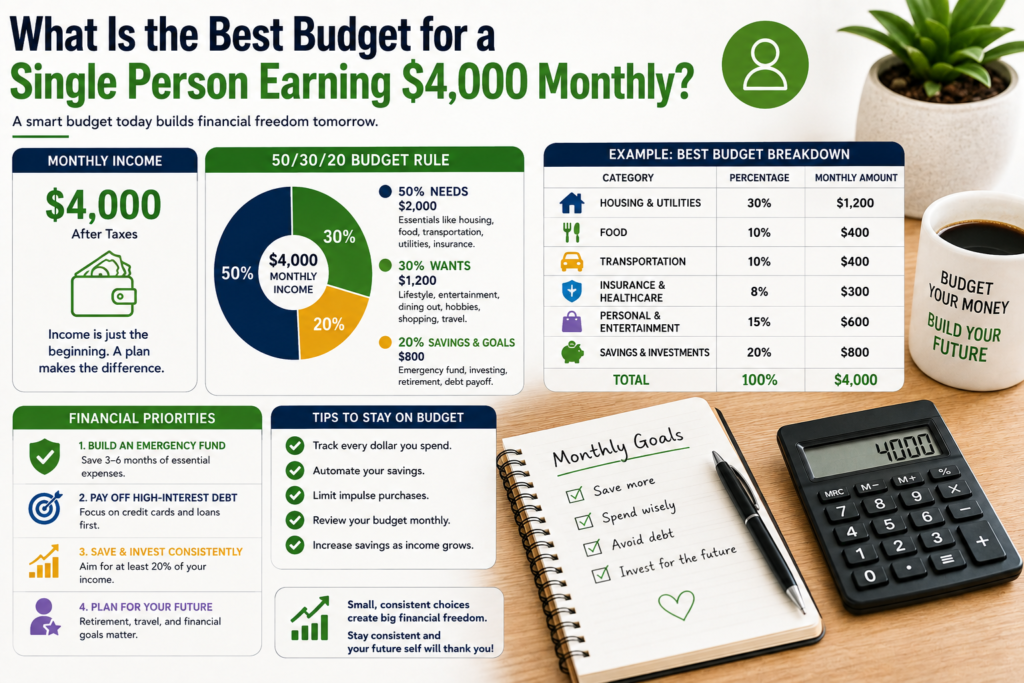
A practical approach is to use the 50/30/20 budgeting rule as a starting framework. Under this method, approximately 50% goes toward needs, 30% toward wants, and 20% toward savings and financial goals.
For a $4,000 monthly income, that could look like this:
| Category | Percentage | Monthly Amount |
|---|---|---|
| Housing & essential bills | 30% | $1,200 |
| Food & transportation | 20% | $800 |
| Wants & entertainment | 30% | $1,200 |
| Savings & investments | 20% | $800 |
| Total | 100% | $4,000 |
This is not a strict formula. If your rent is lower than $1,200, for example, you could redirect the difference toward savings, investments, debt repayment, or other financial goals.
How Much Should You Spend on Housing?
Housing is usually the largest expense for a single person, which makes it one of the most important parts of your budget.
A useful target is to keep rent or housing costs around 25% to 30% of your monthly income when possible. With $4,000 per month, that means approximately $1,000 to $1,200.
If you spend $1,800 on rent, you would have only $2,200 left for everything else. That could make saving, investing, and handling unexpected expenses much more difficult.
If your housing costs are high, consider finding a less expensive apartment, sharing housing, moving to a lower-cost area, or reducing other recurring expenses.
How Much Should You Save on a $4,000 Income?
Saving should be one of the most important priorities in your monthly budget.
A good long-term target is 20% of your income, which would equal $800 per month on a $4,000 income.
That gives you:
- $800 per month
- $9,600 per year
- $48,000 over five years, before investment growth
If you cannot save $800 immediately, start with a smaller amount. Saving $400 per month is still $4,800 per year.
As your income increases or your expenses decrease, gradually increase your savings rate.
Build an Emergency Fund
Before aggressively investing for long-term goals, consider building an emergency fund.
An emergency fund protects you from unexpected expenses such as major car repairs, temporary unemployment, home expenses, or other financial emergencies.
A reasonable goal for many people is three to six months of essential expenses.
If your necessary expenses total $2,500 per month, an emergency fund of $7,500 to $15,000 would provide a meaningful financial cushion.
Keep this money accessible and separate from your everyday spending account so you are less likely to use it for nonessential purchases.
Don’t Forget Debt Payments
Your budget should also account for debt.
Credit cards, personal loans, student loans, and car payments can significantly affect how much money you have available for savings.
If you have high-interest debt, paying it down can be one of the most effective uses of your extra money. You can still save a small emergency fund while aggressively reducing expensive debt.
Once high-interest debt is under control, you can redirect more of your monthly cash flow toward investing and long-term savings.
A Better Budget for Someone Who Wants to Save More
The 50/30/20 rule is useful, but it may not be the best choice for someone who wants to build wealth faster.
For example, a single person earning $4,000 could create a more savings-focused budget:
| Category | Monthly Amount |
|---|---|
| Housing & utilities | $1,100 |
| Food | $400 |
| Transportation | $400 |
| Insurance & essential expenses | $300 |
| Entertainment & personal spending | $600 |
| Savings & investments | $1,200 |
| Total | $4,000 |
This budget saves 30% of monthly income, or $1,200 per month.
That equals $14,400 per year before any investment growth.
The biggest advantage of this approach is that increasing your savings rate can help you reach financial goals significantly faster.
Where Can You Cut Expenses?
If your budget does not leave enough room for savings, start by examining your largest recurring expenses rather than focusing only on small purchases.
Look at:
- Housing
- Car payments
- Insurance
- Dining out
- Subscriptions
- Entertainment
- Shopping
- Travel
- High-interest debt
Cutting a $300 monthly expense can have a much greater impact than eliminating several small $10 purchases.
For example, reducing monthly spending by $300 would free up $3,600 per year that could potentially go toward savings or investments.
Automate Your Savings
One of the easiest ways to stay on budget is to automate your savings.
Instead of waiting until the end of the month to see what is left, transfer your savings shortly after receiving your paycheck.
If your target is $800 per month, you could automatically move $400 from each paycheck into a separate savings or investment account if you are paid twice monthly.
This strategy is often called “paying yourself first.” It makes saving a priority instead of something that happens only when there is money left over.
The Bottom Line
For a single person earning $4,000 monthly, a good budget should cover essential expenses while leaving meaningful room for savings and financial goals.
A practical starting point is the 50/30/20 rule, but you do not have to follow it perfectly. Keeping housing around 25% to 30%, controlling discretionary spending, building an emergency fund, reducing expensive debt, and saving at least 20% can create a strong financial foundation.
If you can eventually increase your savings rate to 25% or 30%, your financial progress can accelerate even further.
The best budget is not necessarily the one that restricts your spending the most. It is the one that allows you to live comfortably today while consistently improving your financial future. Click in Read Next