
Meta Description: How much house can you afford on a $50,000 salary? Learn how lenders calculate affordability, estimate your price range, and avoid becoming house poor.
Buying a home on a $50,000 salary is possible, but the right price depends on much more than your income. Your down payment, credit score, existing debt, mortgage rate, property taxes, insurance, and location can all significantly change what you can comfortably afford.
A lender may approve you for one amount, while your personal budget may support a much lower number. The goal isn’t to buy the most expensive house you qualify for. It’s to find a home that allows you to build equity while still having enough money for savings, emergencies, repairs, and everyday life.
The 28/36 Rule: A Starting Point
One of the most commonly used affordability guidelines is the 28/36 rule.
It suggests that:
- Your housing costs should generally stay around 28% or less of your gross monthly income.
- Your total monthly debt payments, including housing, car loans, student loans, and credit cards, should generally stay around 36% or less of gross income.
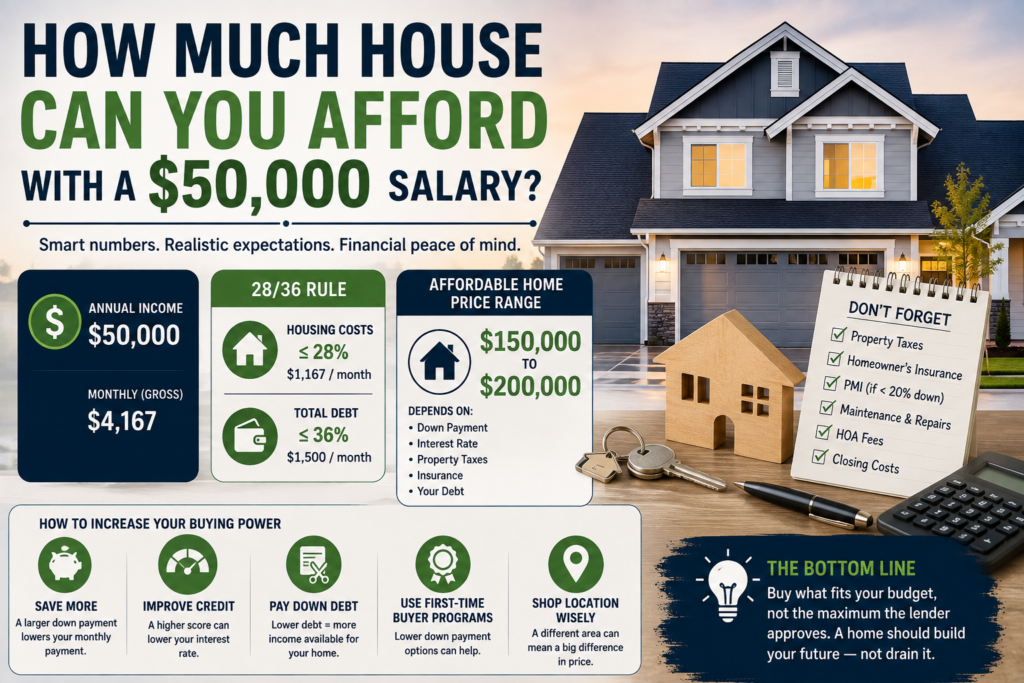
With a $50,000 annual salary, your gross monthly income is approximately $4,167.
Using the 28% guideline:
$4,167 × 28% = approximately $1,167 per month
That $1,167 is not simply your mortgage principal and interest. A realistic housing budget may also need to include property taxes, homeowners insurance, mortgage insurance, and HOA fees.
Think of $1,167 as a starting point rather than a guaranteed maximum.
So, How Much House Can You Afford?
For someone earning $50,000 per year, a reasonable home-price range may be around $150,000 to $200,000, depending on the mortgage rate, down payment, taxes, insurance, and other debts.
For example, someone with:
- Strong credit
- A larger down payment
- Minimal monthly debt
- Moderate property taxes
- Affordable homeowners insurance
may be able to handle a home closer to the upper end of that range.
Someone with a small down payment, significant student loans, a car payment, or high local taxes may need to target a substantially lower price.
Location also matters enormously. A $180,000 home may be relatively affordable in one state but difficult to find—or much more expensive to maintain—in a high-cost housing market.
Why a Lender May Approve More Than You Should Spend
This is one of the most important points for first-time buyers.
A mortgage lender evaluates your ability to repay debt based on income, credit, debt obligations, and other financial factors. Your preapproval amount is not necessarily your personal affordability limit.
For example, you might qualify for a $250,000 mortgage, but that doesn’t mean a $250,000 home fits comfortably into your monthly budget.
The larger the mortgage, the less room you may have for:
- Emergency savings
- Retirement contributions
- Home repairs
- Transportation
- Healthcare
- Travel and entertainment
- Unexpected expenses
Being house poor means owning a home but having very little money left after paying for it.
A better strategy is to treat your lender’s approval as a ceiling—not a target.
Don’t Forget the Hidden Costs of Homeownership
Your mortgage payment is only one part of the cost of owning a home.
1. Property Taxes
Property taxes vary considerably depending on where you live. Even a relatively inexpensive home can have a meaningful annual tax bill.
2. Homeowners Insurance
Insurance premiums depend on location, property type, coverage, and local risks. Your monthly budget should account for this expense from the beginning.
3. Private Mortgage Insurance
If you make a smaller down payment, you may have to pay private mortgage insurance (PMI). PMI can add a significant monthly expense until you meet the requirements for removing it.
4. Maintenance and Repairs
Homes require ongoing maintenance. A broken water heater, roof repair, plumbing problem, or appliance replacement can quickly cost hundreds or thousands of dollars.
A common budgeting guideline is to set aside roughly 1% of the home’s value per year for maintenance, although actual costs vary significantly by property and age.
5. Closing Costs
Buying a home also requires upfront expenses such as lender fees, title costs, appraisal fees, and other closing expenses. Depending on the transaction, these can add thousands of dollars to the amount you need at closing.
6. HOA Fees
If you’re buying in a condominium, townhouse community, or planned development, monthly HOA fees can significantly affect affordability.
How to Increase Your Home-Buying Power on $50,000
You don’t necessarily need a higher salary to improve your position. Several financial moves can increase your affordability while reducing risk.
1. Build a Larger Down Payment
A larger down payment reduces the amount you need to borrow and can lower your monthly payment. Depending on the loan type, putting enough money down may also help you avoid PMI.
However, don’t drain your entire savings account just to make a larger down payment. You still need cash for closing costs, moving expenses, repairs, and emergencies.
2. Improve Your Credit
Your credit profile can affect the mortgage rate and loan terms you receive. Even a relatively small difference in interest rates can have a meaningful effect on the total cost of a mortgage over time.
Before applying, review your credit reports, pay bills on time, and avoid taking on unnecessary new debt.
3. Pay Down Existing Debt
Monthly debt payments directly affect how much income is available for housing.
Paying off a car loan, reducing credit-card balances, or eliminating other recurring debt can improve your debt-to-income ratio and make your monthly budget more flexible.
4. Explore First-Time Buyer Programs
Depending on where you live and your eligibility, programs such as FHA financing, USDA loans, VA loans, and state or local down-payment assistance may reduce the amount of cash needed upfront.
Always compare the long-term costs, not just the initial down payment.
5. Consider a Lower-Cost Location
Location may be the biggest factor of all.
Expanding your search to nearby towns, suburbs, or less expensive markets could allow the same $50,000 income to support a significantly more comfortable lifestyle.
A Realistic Example: Buying a $165,000 Home
Imagine a buyer earning $50,000 per year who purchases a $165,000 home with a 10% down payment.
The buyer’s monthly housing expense could include:
- Mortgage principal and interest
- Property taxes
- Homeowners insurance
- PMI
- Maintenance savings
Depending on the interest rate and local costs, the total monthly housing expense could approach or exceed $1,300–$1,400.
That would represent roughly one-third of gross monthly income.
For someone with little or no other debt, this may be manageable. For someone also paying $500 or $700 per month toward a car loan, student loans, or credit cards, the same house could become financially stressful.
That’s why affordability should always be calculated using your complete monthly budget, not just the home’s purchase price.
The Bottom Line: How Much House Can You Afford on $50,000?
So, how much house can you afford with a $50,000 salary?
For many buyers, a home in the $150,000–$200,000 range may be a reasonable starting point. But the ideal price can be significantly lower or higher depending on your down payment, credit, debt, mortgage rate, property taxes, insurance, and location.
The smartest approach is to work backward from the monthly payment you can comfortably afford rather than starting with the maximum mortgage a lender offers.
A smaller home that allows you to maintain an emergency fund, save for retirement, handle unexpected repairs, and enjoy your life can be a much better financial decision than a larger home that consumes most of your paycheck.
Homeownership on a $50,000 salary isn’t about stretching your budget to the limit. It’s about buying within your means and building long-term financial stability. Click in Read Next: