
Meta Description: How much rent can you afford on a $60,000 salary? Learn the ideal rent range, how to calculate your budget, and how to avoid becoming rent-burdened.
Earning $60,000 a year gives you more housing options than a lower income, but it does not automatically mean you can afford an expensive apartment. The amount you should spend on rent depends on your take-home pay, debt, transportation costs, savings goals, and where you live.
So, how much rent can you afford with a $60,000 salary?
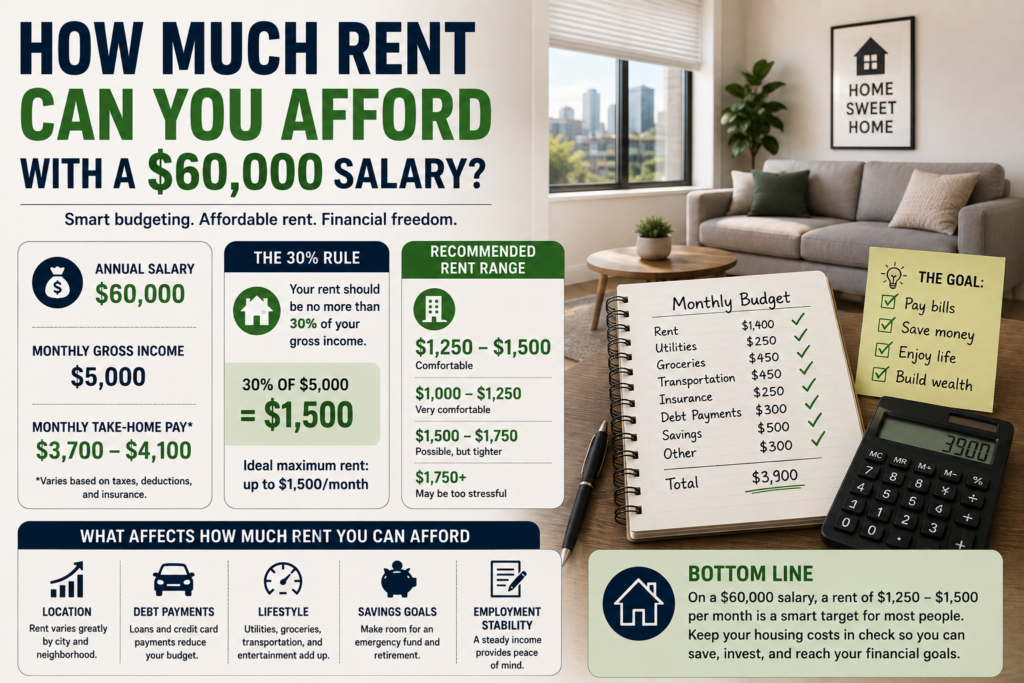
For many renters, a reasonable target is approximately $1,250 to $1,500 per month, although your personal number could be lower or higher depending on your financial situation.
The key is to choose a rent payment that leaves enough money for your other expenses and long-term financial goals.
How Much Is a $60,000 Salary Per Month?
A $60,000 annual salary equals:
$60,000 ÷ 12 = $5,000 gross per month
That’s your income before federal and state taxes, Social Security, Medicare, health insurance, retirement contributions, and other payroll deductions.
Your actual take-home pay will vary depending on where you live and your personal circumstances, but it will be significantly less than $5,000.
That distinction matters because your landlord may evaluate your gross income, while your personal budget should be based on what actually reaches your bank account.
The 30% Rule for Rent
One of the most common housing guidelines suggests keeping rent at around 30% of gross monthly income.
With a $60,000 salary:
$5,000 × 30% = $1,500
That makes $1,500 per month a useful upper guideline for rent.
However, the 30% rule is not a universal answer. Someone with $1,000 in monthly debt payments will have a very different financial situation from someone with no debt.
For that reason, a better approach is to use the 30% rule as a starting point and then adjust it according to your actual budget.
A Comfortable Rent Range on $60,000
For many people earning $60,000 per year, these ranges provide a useful framework:
$1,000–$1,250: Conservative and financially comfortable in many situations.
$1,250–$1,500: Reasonable for someone with manageable debt and stable expenses.
$1,500–$1,750: Possible, but leaves less room for savings and unexpected costs.
$1,750+: Potentially stressful unless your other expenses are unusually low or you have additional household income.
The right number is not necessarily the highest rent you can technically qualify for. It’s the amount that allows you to live comfortably while continuing to save.
Why Location Changes Everything
The same $60,000 salary can provide very different lifestyles depending on where you live.
In a lower-cost city or smaller metro area, $1,300 may rent a comfortable one-bedroom apartment—or even a larger home in some markets.
In expensive cities such as New York, San Francisco, Boston, or parts of Southern California, $1,500 may barely cover a modest apartment or a room in a shared property.
This is why rent affordability is about both income and location.
When housing prices are high, renters may need to compensate by choosing a smaller apartment, getting a roommate, living farther from downtown, or expanding their search to neighboring communities.
Don’t Forget the Cost of Living Beyond Rent
Rent is only one part of your monthly housing budget.
Before signing a lease, consider:
- Utilities
- Internet
- Parking
- Renters insurance
- Transportation
- Groceries
- Healthcare
- Debt payments
- Entertainment
- Emergency savings
- Retirement contributions
For example, an apartment advertised at $1,450 per month may actually cost $1,700 or more after utilities, parking, internet, and other recurring expenses.
That difference can dramatically affect your ability to save.
Example: A $60,000 Salary With $1,400 Rent
Imagine someone earning $60,000 annually who takes home approximately $3,900 per month after taxes and payroll deductions.
Suppose their monthly budget looks like this:
Rent: $1,400
Utilities and internet: $250
Transportation: $450
Groceries: $450
Insurance and healthcare: $250
Debt payments: $300
Savings: $500
Other spending: $300
Total monthly expenses: $3,900
This budget works on paper, but there isn’t much room for unexpected expenses.
Now imagine reducing rent from $1,400 to $1,150. That creates another $250 per month, or $3,000 per year, that could potentially go toward an emergency fund, retirement account, debt repayment, or future home purchase.
That’s why lower rent can have a much bigger financial impact than it first appears.
How to Make $60,000 Go Further
One of the easiest ways to improve your financial position is to keep housing costs under control.
Choose Location Strategically
Moving slightly farther from a major employment center can sometimes reduce rent significantly. Calculate the savings against additional commuting costs before making a decision.
Consider a Roommate
Sharing housing can dramatically reduce your monthly housing expense. The money you save can instead be used to build an emergency fund or increase investments.
Negotiate Your Total Housing Costs
Don’t focus only on advertised rent. Ask about parking, utility fees, application fees, pet fees, deposits, and annual increases.
Increase Income
A side job, freelance work, overtime, or a higher-paying position can make a higher rent easier to manage—but increasing income should not automatically mean increasing your lifestyle.
How Much Rent Should You Really Pay?
So, how much rent can you afford with a $60,000 salary?
For many people, $1,250 to $1,500 per month is a reasonable starting range. Around $1,500 represents 30% of gross monthly income, while a lower figure provides more room for savings and financial flexibility.
Your ideal rent may be significantly different depending on your debt, taxes, transportation costs, household size, and location.
The smartest approach is to determine your rent limit before apartment hunting. Don’t start with the most expensive apartment you think you can qualify for and then build your budget around it.
Start with the lifestyle you want, the financial goals you’re trying to achieve, and the amount you can comfortably afford every month.
The Bottom Line
A $60,000 salary can support a comfortable rental lifestyle, but the goal shouldn’t be to spend as much as possible on housing. Keeping rent around 25% to 30% of gross income can provide a useful balance between enjoying a good home and maintaining financial flexibility.
The best apartment isn’t necessarily the most impressive one you can afford. It’s the one that gives you a comfortable place to live without sacrificing your savings, financial security, or future goals. Click in Read Next: