
Meta Description: How far does $4,000 a month go in different states? Compare the purchasing power of a $48,000 annual income, housing costs, expenses, and lifestyle across America.
Earning $4,000 a month means approximately $48,000 a year before taxes. For one person, that income can provide a reasonable lifestyle in some parts of the United States. In other states, especially areas with expensive housing, the same salary can feel surprisingly tight.
The reason is simple: $4,000 does not have the same purchasing power everywhere in America.
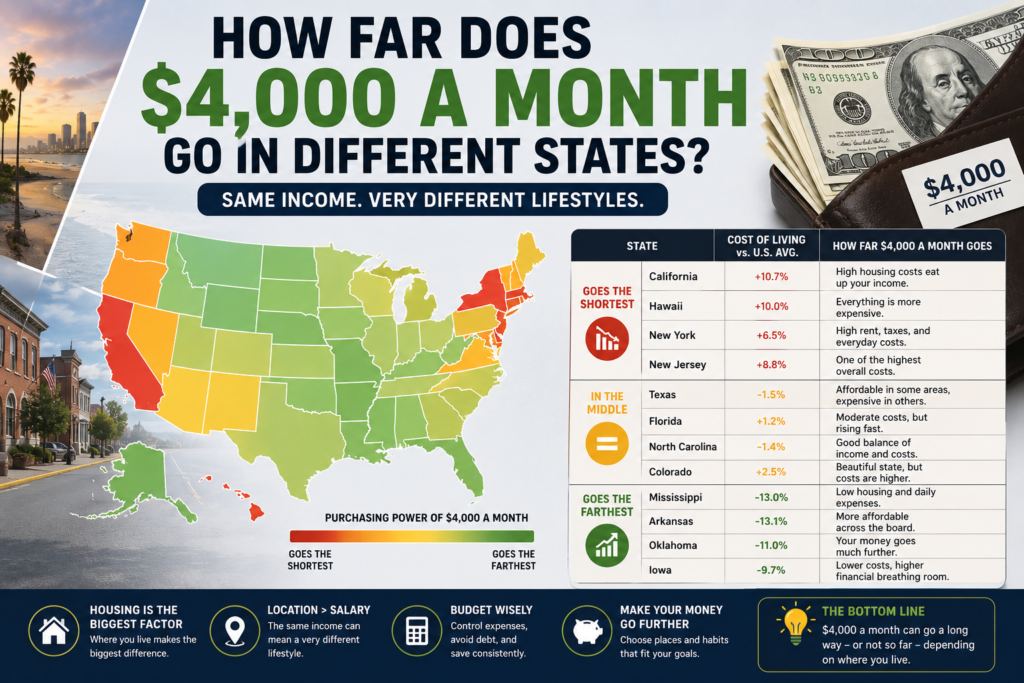
Housing, groceries, transportation, healthcare, taxes, and everyday services can vary significantly from one state to another. The Bureau of Economic Analysis measures these differences through Regional Price Parities, which compare state price levels with the national average. In 2024, California had an all-items price level of 110.7, while Arkansas was at 86.9, illustrating how dramatically purchasing power can vary.
So, where does $4,000 a month go the furthest?
What Does $4,000 a Month Really Mean?
Before comparing states, it is important to understand that $4,000 per month usually refers to gross income.
That equals $48,000 annually before federal taxes, Social Security, Medicare, state taxes where applicable, health insurance, retirement contributions, and other deductions.
Your actual take-home pay will therefore be lower.
The difference between gross and net income becomes particularly important when comparing expensive and affordable states. A person taking home $3,200 a month in a low-cost area may have more disposable income than someone with the same take-home pay living in an expensive metropolitan area.
States Where $4,000 Can Stretch Further
Lower-cost states generally give a $4,000 monthly income more purchasing power.
States such as Arkansas, Mississippi, Iowa, Oklahoma, and Alabama tend to have lower overall price levels than many expensive coastal states. The BEA’s 2024 data placed Arkansas at 86.9 and Mississippi at 87.0, both well below the national price level of 100.
That does not mean every city in these states is inexpensive. Local housing markets can vary considerably. However, lower average prices can give a $4,000 income more room for housing, transportation, groceries, savings, and discretionary spending.
For a single person, this can make $4,000 a month feel relatively comfortable when major expenses are controlled.
The Middle of the Pack: States With Moderate Costs
In states with prices closer to the national average, $4,000 a month can provide a balanced but still budget-conscious lifestyle.
States such as Georgia, Arizona, Illinois, Pennsylvania, and North Carolina can offer a wide range of living costs depending on the city or region.
This is where location within the state becomes extremely important.
Living in a smaller city or suburban community can be dramatically different from living in a major metropolitan area. Rent, transportation, and lifestyle expenses may determine whether $4,000 feels comfortable or restrictive.
For this reason, looking only at state averages is not enough. The BEA notes that its regional price data can also be used to compare metropolitan areas, which can provide a more precise picture of purchasing power.
Expensive States Can Make $4,000 Feel Much Smaller
The biggest challenge appears in states with high housing and overall living costs.
In 2024, California, Hawaii, and New Jersey had the highest all-items Regional Price Parities among states, at 110.7, 110.0, and 108.8 respectively.
Housing can make the difference especially obvious.
California had a 2024 housing-rent price parity of 154.3, meaning housing rents were substantially more expensive than the national benchmark.
Someone earning $4,000 a month in an expensive California city could therefore face much greater housing pressure than someone earning the same amount in a lower-cost state.
The salary has not changed.
The purchasing power has.
Housing Is Usually the Biggest Factor
When determining how far $4,000 a month can go, housing deserves special attention.
If your rent is $1,000 per month, you have $3,000 remaining before other expenses.
If rent is $2,000, only $2,000 remains.
That difference can completely change your ability to save, invest, pay down debt, or handle emergencies.
This is why moving to a lower-cost state—or choosing a lower-cost city within your current state—can sometimes have an impact comparable to receiving a significant raise.
Household Size Changes Everything
A $4,000 monthly income also goes much further for one person than for a household supporting several people.
A single adult may be able to manage housing, food, transportation, insurance, and savings on this income in a lower-cost area.
A family with children faces additional expenses such as childcare, healthcare, food, clothing, education, and larger housing requirements.
MIT’s Living Wage Calculator specifically accounts for differences in location and family structure, offering estimates for individuals and households with different numbers of adults and children. Its latest data was updated in February 2026.
This reinforces an important point: there is no universal answer to whether $4,000 a month is enough.
How to Make $4,000 a Month Go Further
Regardless of where you live, several strategies can increase the purchasing power of your income.
First, control housing costs whenever possible. Second, avoid excessive car payments and other large fixed expenses. Third, pay down high-interest debt and build an emergency fund.
You should also compare your actual expenses with your take-home pay every month.
A simple budget might divide your income into four major categories:
- Essential expenses
- Debt repayment
- Savings and investments
- Discretionary spending
The goal is not simply to spend less. It is to create enough financial margin that you can save consistently and handle unexpected expenses.
Where Does $4,000 a Month Go the Furthest?
There is no single “best” state because everyone’s circumstances are different.
However, $4,000 a month generally stretches further in states with lower overall price levels and affordable housing than in states where housing and other costs are significantly above the national average.
The difference can be substantial.
A $48,000 annual income in a lower-cost community may allow a person to save and invest regularly. The same gross income in an expensive coastal city could leave little room after rent, transportation, and basic necessities.
Final Thoughts
So, how far does $4,000 a month go in different states?
The answer depends heavily on housing costs, location, household size, taxes, transportation, and everyday expenses.
Current BEA data confirms that price levels vary considerably across the United States, while MIT’s Living Wage Calculator shows that the income needed to meet basic needs changes based on both location and family size.
The most important lesson is that your salary is only one part of your financial picture.
$4,000 a month in America can feel very different depending on where you live.
In a low-cost state, it may provide room to save, invest, and build wealth. In an expensive state, careful budgeting may be necessary just to maintain financial stability.
Understanding your local cost of living—and keeping your largest expenses under control—is ultimately what determines how far your $4,000 monthly income can really go.