
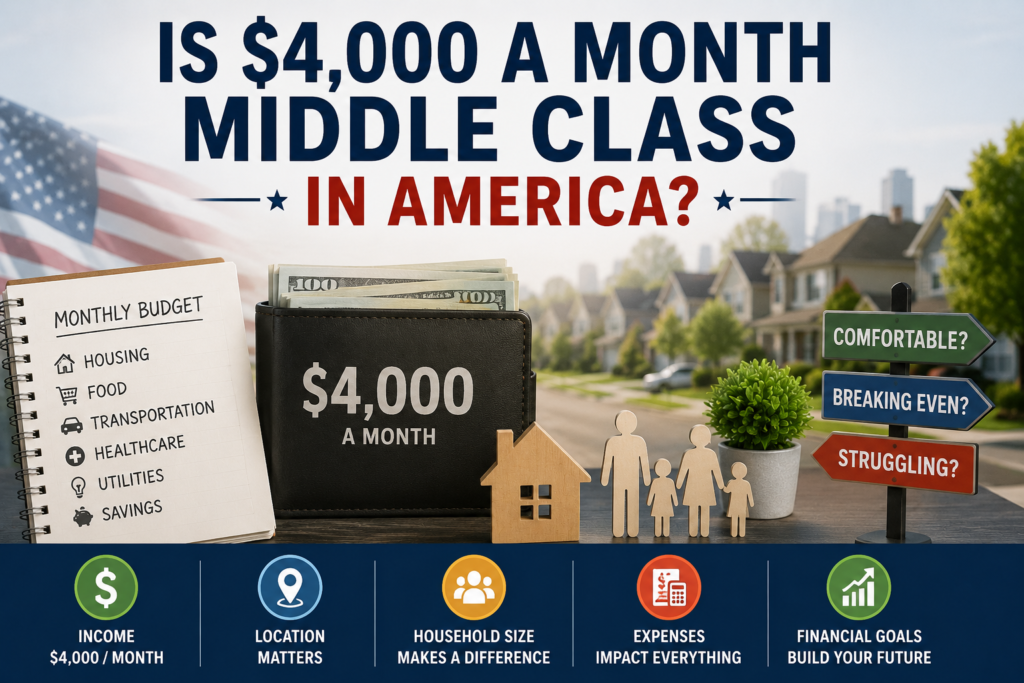
Meta Description: Is $4,000 a month considered middle class in America? Learn how household size, location, taxes, housing costs, and lifestyle affect what $4,000 a month can realistically afford.
Earning $4,000 a month sounds like a solid income at first glance. That equals approximately $48,000 a year before taxes, but whether it qualifies as middle class in America is not as simple as looking at one number.
Your financial position depends on where you live, whether you are single or supporting a family, how much you pay for housing, and how much of your income remains after taxes and essential expenses.
For some people, $4,000 a month can provide a reasonably comfortable lifestyle. For others, especially those supporting a household in an expensive city, it may feel closer to a tight budget.
So, is $4,000 a month middle class in America? The answer is: it can be, but context matters.
What Does Middle Class Actually Mean?
There is no single income number that officially defines the American middle class.
Economists and researchers generally consider several factors when defining middle-class households, including income, household size, geographic location, and the cost of living.
This is important because $48,000 for one person is very different from $48,000 for a family of four.
A single person earning $4,000 per month may have enough income to cover necessities, save money, and enjoy some discretionary spending. A household supporting several people on the same income could face much greater financial pressure.
That is why income alone does not tell the complete story.
$4,000 a Month Before Taxes vs. After Taxes
Another important distinction is whether the $4,000 figure represents gross income or take-home pay.
If you earn $4,000 per month before taxes, your actual take-home pay will be lower after federal taxes, Social Security, Medicare, state taxes where applicable, retirement contributions, health insurance, and other deductions.
This can significantly change your monthly budget.
For example, someone earning $4,000 gross may have considerably less than $4,000 available for rent, groceries, transportation, savings, and entertainment.
For financial planning purposes, it is therefore more useful to ask:
How much of that $4,000 actually reaches your bank account?
Your net income determines your real spending power.
Location Can Change Everything
One of the biggest factors determining whether $4,000 a month feels middle class is where you live.
The same salary can produce completely different lifestyles across the United States.
In a lower-cost area, $4,000 a month may provide enough room for affordable housing, transportation, groceries, savings, and entertainment.
In a high-cost metropolitan area, however, rent alone can consume a substantial portion of your monthly income.
Someone paying $1,100 for housing has a very different financial situation from someone paying $2,500 for the same basic necessity.
This is why national income comparisons can sometimes be misleading. Your purchasing power is heavily influenced by your local cost of living.
Can You Live Comfortably on $4,000 a Month?
For a single person, $4,000 in gross monthly income can potentially support a reasonable lifestyle with disciplined budgeting.
A sample monthly budget might look like:
- Housing: $1,200
- Utilities and internet: $250
- Groceries: $450
- Transportation: $400
- Insurance: $250
- Debt payments: $300
- Savings and investments: $500
- Entertainment and miscellaneous expenses: $300
That leaves some flexibility for additional savings, unexpected expenses, or lifestyle spending.
Of course, these numbers are only an illustration. Actual costs vary dramatically depending on location, household size, debt, transportation needs, and personal choices.
The larger point is that $4,000 can work well when fixed expenses remain under control.
What About a Family Earning $4,000 a Month?
The situation becomes considerably different when multiple people depend on the same income.
A household with children may have higher costs for housing, food, healthcare, transportation, childcare, clothing, education, and other necessities.
At that point, $48,000 in annual gross income may provide much less financial flexibility.
This does not necessarily mean the household is “poor,” nor does it automatically mean it is middle class. It demonstrates why household size is essential when discussing income categories.
A single worker and a family cannot realistically be evaluated using exactly the same income threshold.
The Difference Between Being Middle Class and Feeling Middle Class
There is also an important psychological difference between being classified as middle income and feeling financially comfortable.
Someone earning $4,000 a month may technically fall within a middle-income range in certain circumstances but still feel financially stressed.
Why?
Because financial comfort depends on more than income.
High rent, credit card debt, car payments, medical expenses, or a lack of emergency savings can make a moderate income feel inadequate.
Meanwhile, someone earning the same amount with low housing costs, no high-interest debt, and strong savings habits may feel considerably more secure.
In other words:
Income determines how much money comes in. Your expenses determine how much financial freedom you have.
How to Make $4,000 a Month Go Further
If you earn $4,000 a month, controlling your largest expenses can make the biggest difference.
Start by keeping housing costs reasonable. Avoid allowing a car payment to consume too much of your monthly income. Pay down high-interest debt and build an emergency fund.
Then consider automating your savings.
Even setting aside $300 to $500 every month can create meaningful progress over time. Once your emergency savings are established, increasing retirement contributions and long-term investments can help turn income into wealth.
The goal is not necessarily to live as cheaply as possible.
The goal is to create enough financial margin that an unexpected expense does not completely disrupt your budget.
Is $4,000 a Month Enough to Build Wealth?
Yes, it can be—but the process may require more discipline than it would at a higher income.
Building wealth is not exclusively about earning a large salary. It also depends on your savings rate, debt level, investment habits, and the amount of time you allow your money to grow.
Someone earning $4,000 who consistently saves and invests may eventually build greater wealth than someone earning substantially more but spending nearly everything.
As your income increases, one of the smartest strategies is to avoid immediately increasing your lifestyle. Instead, direct part of every raise toward investments, retirement savings, and financial goals.
Final Verdict: Is $4,000 a Month Middle Class in America?
So, is $4,000 a month middle class in America?
There is no universal yes-or-no answer.
For a single person in a relatively affordable area, $4,000 a month can provide a solid middle-income lifestyle. For a larger household or someone living in an expensive city, the same income can feel significantly more restrictive.
The most important factors are household size, location, taxes, housing costs, debt, and spending habits.
Ultimately, the better question may not be whether $4,000 a month makes you middle class.
It is whether your income allows you to cover your needs, save consistently, handle emergencies, and make progress toward your financial goals.
Because financial success is not determined by a label. It is determined by what you are able to do with the money you earn.