
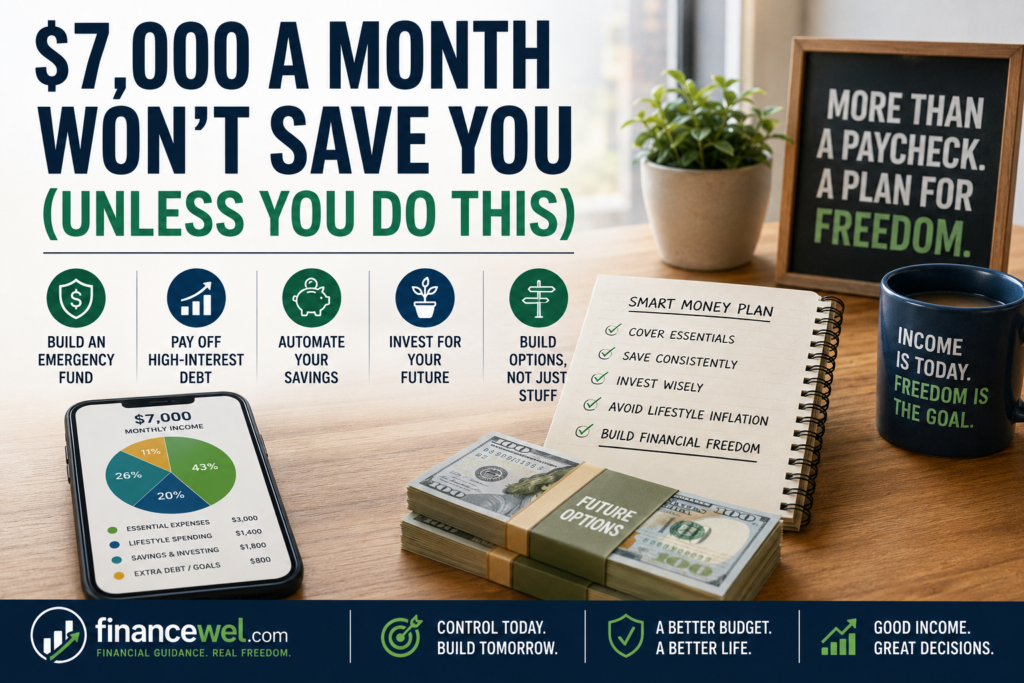
There’s a fantasy a lot of people carry around: “once I make X, I’ll stop worrying about money.” The problem is X keeps moving, and the worry moves right along with it. Earning $7,000 a month isn’t a financial finish line. It’s just the starting point of a decision you keep making — or keep avoiding — every single month.
You can pull in $84,000 a year and still live paycheck to paycheck if your mortgage, your car payment, your subscriptions, your dinners out, and your weekend trips grow at the same pace as your income. This isn’t a hypothetical. It’s the default outcome for almost anyone who gets a raise without changing the system underneath it.
The gap between “earning well” and “being okay” isn’t in the number on your paycheck. It’s in what happens after that money lands in your account.
If you’re bringing home $7,000 a month, the goal isn’t to spend it more stylishly. The goal is to build enough margin that a surprise expense doesn’t blow up your plans — and to make that income eventually buy you something more valuable than stuff: options.
1. Before You Divide Anything, Find Out What’s Actually Yours
The first mistake almost everyone makes: budgeting off the gross number.
If your salary is $7,000 on paper, what actually hits your checking account can be a lot less. Federal and state taxes, Social Security, Medicare, health insurance, retirement contributions — all of it takes a bite before you ever see a cent.
Your budget needs to start from take-home pay, not the number that looked good on the offer letter.
Earn $7,000 gross but only see $5,200? Planning around $7,000 is building on sand — it collapses the first month reality doesn’t match the spreadsheet.
But if $7,000 really is what lands in your account, you’re working with a genuinely large amount of room to live, save, invest, and dig out of debt.
2. Split the Money Into Blocks, Not Excuses
A reasonable starting point — not a universal law — is splitting income into four broad buckets:
| Category | Example |
|---|---|
| Essential expenses | $3,000 |
| Lifestyle spending | $1,400 |
| Savings & investing | $1,800 |
| Extra debt payoff / goals | $800 |
This is a template, not a recipe. Your real percentages depend on your housing, your family situation, your debt, your city, and what you’re actually trying to achieve. Someone living alone in a cheap area can save far more than someone supporting a family in an expensive one.
What matters isn’t whether your budget looks like someone else’s. What matters is whether, after you spend, something is still left working for your future.
3. Housing Is the One Decision That Shapes All the Others
Of every line in your budget, housing has the most power to sabotage it — or set it free.
Put $3,000 toward rent or a mortgage, and you’ve already committed over 40% of your income before you’ve bought a single vegetable. That doesn’t automatically make it a bad call, but it does shrink your room to maneuver everywhere else.
A cheaper home can free up thousands of dollars a year. Multiply that over time, and it’s the difference between actually investing and just surviving with better decor.
Don’t just ask “can I afford this?” Ask the more uncomfortable, more useful question:
What does this house stop me from doing with my money?
That question exposes the opportunity cost that expensive housing hides so well.
4. Not Every Recurring Bill Is a Necessity
Confusing “necessary” with “habitual” is a quiet trap.
Rent might be necessary. That $180 phone bill probably isn’t. Groceries are necessary. Ordering delivery four nights a week is a choice. Transportation might be necessary. Financing a luxury car with a fat monthly payment isn’t.
This isn’t about cutting everything you enjoy. It’s about being honest with yourself about which expenses are actually unavoidable and which ones exist simply because your lifestyle quietly expanded. Once you can see the difference, you get to decide — instead of just paying out of habit.
5. The Emergency Fund Comes Before the Exciting Investment
At $7,000 a month, the pull toward jumping straight into investing is real. But no portfolio replaces a cash cushion.
Start by building a reserve that can absorb the unexpected. A common target is three to six months of essential expenses. If your core costs run about $3,000 a month, that’s a fund somewhere between $9,000 and $18,000.
The exact number depends on how stable your job is, what you’re responsible for, and what your insurance actually covers. This money isn’t there to perform. It’s there so an emergency doesn’t turn into a crisis.
6. Settle Up With Expensive Debt
High-interest debt deserves special attention.
If you’re carrying credit card balances, the interest is working against you every single month. In that situation, wiping it out can deliver a more reliable return than putting extra money into investments elsewhere.
One practical approach is the avalanche method: pay the minimum on everything, and throw any extra at the debt with the highest interest rate. Once that one’s gone, move to the next.
The psychological alternative is the snowball method: attack the smallest balance first. It’s less efficient on paper, but quick wins keep a lot of people motivated enough to stick with it.
The best method is ultimately the one you’ll actually follow through on.
7. Automate Your Future Before Your Present Spends It
The most common financial mistake is assuming you’ll save whatever’s left at the end of the month. In practice, almost nothing is ever left.
The fix is making saving automatic. If you’re taking home $7,000, you can decide that $1,500 or $2,000 moves out on its own — toward retirement, investing, or your emergency fund — without waiting on a conscious decision every time.
That shifts the real question. It’s no longer:
“How much can I save this month?”
It becomes:
“How much am I allowed to spend after paying my future self?”
Small shift in wording. Massive shift in outcome.
8. Watch Out for the $7,000 Lifestyle Trap
One of the most dangerous financial moments is the exact moment your income goes up.
The raise lands, and almost without deciding to, you move into a pricier apartment, finance a newer car, start eating at a different tier of restaurant, and travel on a bigger budget. None of it feels like a mistake because, technically, you can afford it all.
But your net worth barely moves.
That’s lifestyle inflation. The fix isn’t denying yourself every upgrade — it’s deciding in advance how you’ll split every future raise: a slice for enjoying life now, the majority toward investing, debt payoff, or savings. That way your quality of life improves without every extra dollar quietly evaporating into new fixed costs.
What a Solid $7,000 Budget Should Actually Do
A budget that works does more than keep your account above zero. Over time, it should let you:
- Cover essentials without stress
- Keep a real emergency fund
- Wipe out high-interest debt
- Save consistently for retirement
- Invest with a long horizon in mind
- Spend on what you enjoy without guilt
- Avoid lifestyle inflation
- Grow your net worth year over year
And there’s one metric almost nobody tracks: how much freedom you’re actually building. Someone earning $7,000 and saving $2,000 a month can end up in a far stronger position than someone earning $10,000 and spending $9,800 of it.
Income opens the door. What you save, spend, and invest is what actually walks through it.
The Bottom Line
Budgeting on $7,000 a month doesn’t mean living like you’re broke. If anything, it’s the opposite.
A good budget gives you permission to enjoy your money — precisely because you already know the essentials are handled and your future is funded.
The goal isn’t ending each month with the highest possible balance. The goal is building a system where today’s income expands tomorrow’s options.
Learn how to budget, save, and invest on a $10,000 monthly income with our complete budget guide.