
Managing $4,000 a month as a couple can provide a comfortable financial foundation, but the way that money is divided matters just as much as the amount you earn. Housing, food, transportation, debt, entertainment, and savings can quickly consume a household income if there is no clear plan.
So, what is the best budget for a couple earning $4,000 monthly? A practical budget should cover essential expenses, allow room for enjoyable spending, and prioritize savings and financial security. While every couple has different circumstances, a structured approach can make $4,000 go much further.
A Simple $4,000 Monthly Budget for a Couple
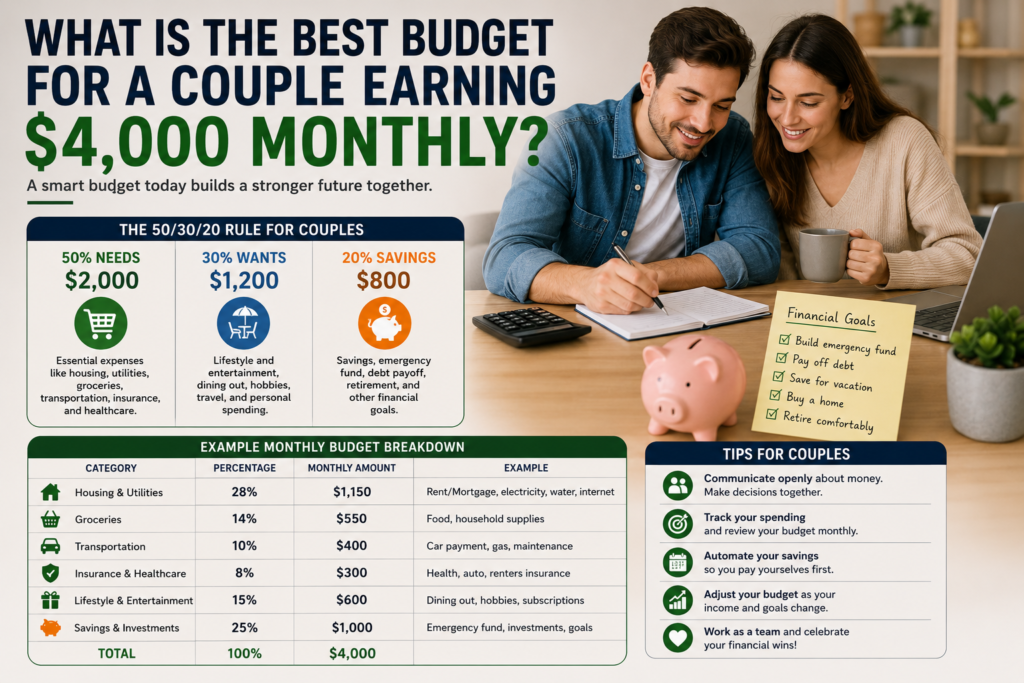
One useful starting point is the 50/30/20 budgeting rule. This framework divides income into approximately 50% for needs, 30% for wants, and 20% for savings and financial goals.
For a couple earning $4,000 per month, that would mean:
| Category | Percentage | Monthly Amount |
|---|---|---|
| Essential needs | 50% | $2,000 |
| Wants & lifestyle | 30% | $1,200 |
| Savings & financial goals | 20% | $800 |
| Total | 100% | $4,000 |
This is a guideline rather than a strict rule. Couples with expensive housing or significant debt may need to adjust the percentages, while couples with lower expenses may be able to save considerably more.
How Much Should a Couple Spend on Housing?
Housing is usually the largest expense in a household budget, making it one of the first categories to control.
A reasonable goal is to keep rent or mortgage costs around 25% to 30% of monthly income when possible. On a $4,000 income, that means approximately $1,000 to $1,200 per month.
If housing costs $1,500 or more, the couple has less money available for groceries, transportation, debt repayment, and savings.
Lower housing costs can make a major difference. Choosing a less expensive apartment, refinancing when appropriate, sharing certain costs, or moving to a lower-cost area could free up hundreds of dollars each month.
How Much Should a Couple Spend on Food?
Food is another important category for couples because grocery and dining expenses can easily become unpredictable.
A reasonable starting budget might be around $500 to $700 per month for groceries, depending on location, dietary preferences, and household habits.
Planning meals, shopping with a list, preparing food at home, and limiting unnecessary restaurant spending can help keep food costs under control.
For example, reducing food spending by $200 per month would free up $2,400 per year that could instead go toward savings or debt repayment.
How Much Should a Couple Save on $4,000 a Month?
Savings should be a major part of the budget.
Using the 20% guideline, a couple earning $4,000 per month would aim to save approximately $800 every month.
That equals:
- $800 per month
- $9,600 per year
- $48,000 over five years
These figures do not include potential investment growth.
If saving $800 immediately is difficult, start with a smaller amount and increase it over time. Even $400 per month would result in $4,800 saved each year.
The important goal is to establish a consistent savings habit.
Build an Emergency Fund
An emergency fund is particularly important for couples because an unexpected expense can affect the entire household budget.
Unexpected costs could include car repairs, medical bills, home repairs, job loss, or other emergencies.
A common goal is to maintain three to six months of essential expenses in an easily accessible savings account.
If the couple’s essential expenses are $2,500 per month, a potential emergency fund target would be between $7,500 and $15,000.
This financial cushion can reduce the need to rely on credit cards or high-interest loans when something goes wrong.
Don’t Ignore Debt
Debt payments should be included before creating a large discretionary spending budget.
Credit cards with high interest rates can make it difficult to build wealth because interest can consume a significant portion of your monthly cash flow.
A couple earning $4,000 may want to prioritize paying down high-interest debt while maintaining a basic emergency fund.
Once expensive debt is under control, the money previously used for debt payments can be redirected toward savings, retirement accounts, investments, or other financial goals.
A Savings-Focused Budget for Couples
Couples who want to reach financial goals faster can create a more aggressive savings plan.
For example:
| Expense Category | Monthly Budget |
|---|---|
| Housing & utilities | $1,150 |
| Groceries | $550 |
| Transportation | $400 |
| Insurance & essential bills | $300 |
| Entertainment & personal spending | $600 |
| Savings & investments | $1,000 |
| Total | $4,000 |
This example allows the couple to save 25% of their monthly income, or $1,000 per month.
At that rate, they could potentially save $12,000 in one year and $60,000 over five years before investment growth.
The exact numbers will depend on their actual expenses, but the example demonstrates how controlling major costs can create additional room for savings.
How Couples Can Save More Money
Saving more does not always mean eliminating everything enjoyable. Instead, focus on the expenses that have the greatest impact.
Review categories such as:
- Housing
- Transportation
- Groceries
- Insurance
- Subscriptions
- Dining out
- Shopping
- Entertainment
- Debt interest
A $300 reduction in recurring monthly expenses creates $3,600 of additional cash flow per year.
Couples should also consider automating savings. Setting up an automatic transfer immediately after receiving income makes saving a routine rather than an afterthought.
Create Shared Financial Goals
One advantage couples have is the ability to work toward financial goals together.
Instead of simply saying, “We need to save more,” create specific targets.
For example, you might establish separate goals for:
Emergency fund: $10,000
Vacation: $2,000
Home down payment: $20,000
Retirement: Monthly contributions
Debt payoff: A specific balance and deadline
Clear goals make it easier to decide which expenses are worth keeping and which ones can be reduced.
The Bottom Line
The best budget for a couple earning $4,000 monthly is one that balances today’s lifestyle with tomorrow’s financial security.
The 50/30/20 rule is a useful starting point, with approximately $2,000 for needs, $1,200 for wants, and $800 for savings and financial goals. However, couples who keep housing and lifestyle expenses under control may be able to save 25% or more.
The most important thing is not following a perfect percentage. It is creating a realistic plan, communicating about money, controlling unnecessary expenses, building an emergency fund, paying down expensive debt, and consistently saving for the future.
With the right strategy, $4,000 a month can become more than just income—it can become the foundation for long-term financial stability and greater financial freedom. Click in Read Next: