
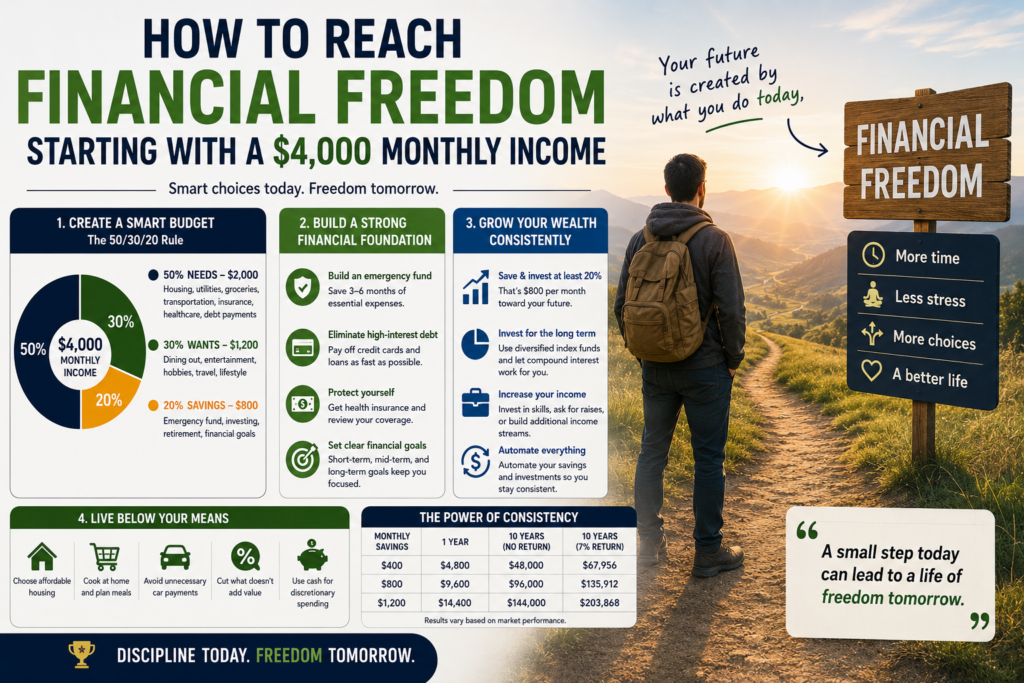
Financial freedom does not necessarily begin with a six-figure salary. It starts with learning how to control the money you already earn. For someone bringing home $4,000 per month, reaching financial freedom may seem difficult, but with the right strategy, consistent saving, controlled spending, and long-term investing, that income can become a powerful foundation for building wealth.
The goal is not to become wealthy overnight. Financial freedom is about creating enough financial stability and assets that you have greater control over your time, choices, and future.
What Does Financial Freedom Really Mean?
Financial freedom means having enough financial resources to handle your lifestyle and future needs without depending entirely on your next paycheck.
For some people, it means being debt-free. For others, it means having enough investments to eventually cover their living expenses. It could also mean having a large emergency fund, owning a home, retiring early, or simply having the freedom to change jobs without worrying about immediate financial problems.
With a $4,000 monthly income, the first step is to create a financial system that consistently moves money toward those goals.
Start With a Realistic $4,000 Monthly Budget
Before investing or aggressively saving, you need to understand where your money goes.
A simple starting point is the 50/30/20 budgeting rule:
| Category | Percentage | Monthly Amount |
|---|---|---|
| Needs | 50% | $2,000 |
| Wants | 30% | $1,200 |
| Savings & financial goals | 20% | $800 |
| Total | 100% | $4,000 |
This is only a framework. If you can keep your lifestyle below $4,000, the money you free up can accelerate your progress toward financial independence.
For example, increasing your savings rate from 20% to 25% would mean saving $1,000 per month instead of $800.
Keep Your Biggest Expenses Under Control
Small purchases matter, but your largest recurring expenses usually have the greatest impact on your financial future.
Focus on controlling:
- Housing
- Transportation
- Food
- Insurance
- Debt payments
- Recurring subscriptions
- Lifestyle expenses
Housing is especially important. If you can keep rent or mortgage costs around 25% to 30% of your income, you may have significantly more room for savings and investing.
Similarly, avoiding an expensive car payment can free up hundreds of dollars every month.
The objective is not to live an extremely restrictive lifestyle. It is to avoid allowing fixed expenses to consume most of your income.
Build an Emergency Fund
Financial freedom begins with financial stability.
An emergency fund protects your long-term investments and savings when unexpected expenses appear. Without one, a medical bill, car repair, or temporary loss of income could force you to use credit cards or sell investments at the wrong time.
A common target is three to six months of essential expenses.
If your necessary expenses are $2,500 per month, your emergency fund could eventually reach approximately $7,500 to $15,000.
You do not need to build this amount immediately. Start with your first $1,000, then gradually work toward a larger financial cushion.
Eliminate High-Interest Debt
High-interest debt can be one of the biggest obstacles to financial freedom.
Credit card balances can grow rapidly when interest charges accumulate, making it harder to save and invest.
If you have expensive debt, consider directing additional cash toward paying it down while maintaining a basic emergency fund.
For example, if you have $600 available after covering your essential expenses and minimum payments, you might use a significant portion of that money to eliminate high-interest balances.
Once the debt is gone, redirect the former payment toward investments and savings.
This creates a powerful financial cycle: less debt → more cash flow → more investing → greater financial independence.
Try to Save at Least 20% of Your Income
A strong long-term goal for someone earning $4,000 per month is to save and invest at least 20% of income.
That equals:
$800 per month
or
$9,600 per year.
Over five years, contributing $800 every month would result in $48,000 contributed, before considering potential investment growth.
If your expenses are low enough, consider increasing the savings rate to 25% or 30%.
At a 30% savings rate, you would invest or save approximately $1,200 per month, or $14,400 per year.
The higher your savings rate, the more quickly you can build the assets needed for long-term financial freedom.
Increase Your Income Over Time
Saving money is important, but there is a limit to how much you can cut from your expenses.
Increasing your income can provide another powerful path toward financial independence.
Consider developing skills that can increase your earning potential, negotiating your salary, pursuing higher-paying opportunities, freelancing, or creating an additional income stream.
The key is to avoid immediately increasing your lifestyle whenever your income rises.
For example, if your income increases from $4,000 to $4,500 per month, you could direct much of the additional $500 toward savings or investments rather than spending it all.
This strategy is known as lifestyle inflation control.
Invest for Long-Term Growth
Saving money protects your financial foundation, but investing can help your money grow over time.
Once you have an emergency fund and have addressed high-interest debt, consider investing for long-term goals through diversified investments that match your risk tolerance and time horizon.
The advantage of investing is the potential for compound growth. Your returns can generate additional returns, allowing your wealth to grow over many years.
For example, consistently investing $800 per month for decades could potentially build a substantial portfolio, although actual returns will vary and investments always involve risk.
The earlier you start, the more time your money has to potentially compound.
Automate Your Financial Freedom Plan
One of the easiest ways to stay consistent is to automate your finances.
Instead of waiting until the end of the month to see what remains, set up automatic transfers shortly after receiving your income.
For example:
Income: $4,000
Automatic savings/investing: $800
Remaining spending money: $3,200
Automation removes the temptation to spend money that was supposed to be saved.
You can also create separate accounts for different purposes, such as emergency savings, short-term goals, and long-term investments.
Set Specific Financial Goals
Financial freedom becomes easier to achieve when you have measurable goals.
Instead of simply saying, “I want to be financially free,” create specific milestones.
For example:
Goal 1: Save the first $1,000 emergency fund.
Goal 2: Build three months of essential expenses.
Goal 3: Eliminate high-interest debt.
Goal 4: Invest $10,000.
Goal 5: Reach $50,000 in savings and investments.
Goal 6: Increase your savings rate as your income grows.
Each milestone provides a clear target and makes long-term progress easier to track.
How Long Could Financial Freedom Take?
There is no universal timeline.
Your path depends on your income, expenses, savings rate, investment returns, debt, lifestyle, and financial goals.
Someone who spends $3,800 of their $4,000 income each month will have a very different trajectory from someone who lives on $2,800 and invests $1,200.
This is why your savings rate is so important.
Increasing your income while keeping your lifestyle under control can dramatically improve your financial position over time.
The Bottom Line
Reaching financial freedom with a $4,000 monthly income is possible, but it requires a long-term strategy rather than a quick financial trick.
Start by creating a realistic budget, controlling your largest expenses, building an emergency fund, eliminating high-interest debt, and saving or investing at least 20% of your income when possible.
Then focus on increasing your income and avoiding unnecessary lifestyle inflation. As your earnings grow, increase the amount you save and invest rather than allowing every raise to disappear into higher spending.
Financial freedom is not determined by how much money you make alone. It is determined by how much you keep, how consistently you save, how wisely you invest, and how effectively you use your income to build long-term financial security.
Starting with $4,000 a month may not make you financially independent immediately, but disciplined decisions today can put you on a path toward greater freedom tomorrow.