
Having $4,000 a month can mean a comfortable life or a constant source of financial stress,
depending on how that money is organized. The difference between reaching the end of the month
with peace of mind or living on the edge lies less in how much you earn and more in the strategy
used to allocate it. Below is a practical guide to intelligently managing a $4,000 monthly budget,
backed by recent data on the financial habits of U.S. households.
The current financial landscape
Before diving into strategy, it’s worth understanding the context. Several recent studies paint a
revealing picture of how U.S. households manage their money:
Just over half of U.S. adults, 53%, say they have a set budget this year, up from 46% the
previous year.
Among those who budget, the top reason—cited by 66%—is making sure they can cover
essentials: food, rent, and bills.
On average, U.S. households spend about 88% of their net income, leaving only about 12%
for savings, far below the 20% recommended by most personal finance experts.
The national personal savings rate hovers around 3.8%, considered low by historical
standards.
The cost of living keeps rising: the monthly spending needed to maintain an average family
standard of living went from roughly $5,100 in 2020 to about $6,400 today, an increase of
more than $1,300 a month in just a few years.
This data confirms something important: a $4,000 monthly budget requires more discipline than
ever, especially in high-cost-of-living areas, and getting ahead of the national trend of low savings
is, in itself, a competitive advantage for personal financial health.
- Know your real income and expenses
Before creating any plan, it’s essential to have complete clarity about the money coming in and
going out each month. Many people underestimate their expenses because they don’t keep detailed
records. The first step is to write down absolutely everything: rent, utilities, transportation, food,
entertainment, and those small “invisible” expenses like subscriptions or impulse purchases. Only
with this real information can you build a budget that works in practice, not just on paper. - Apply the 50/30/20 rule as a starting point
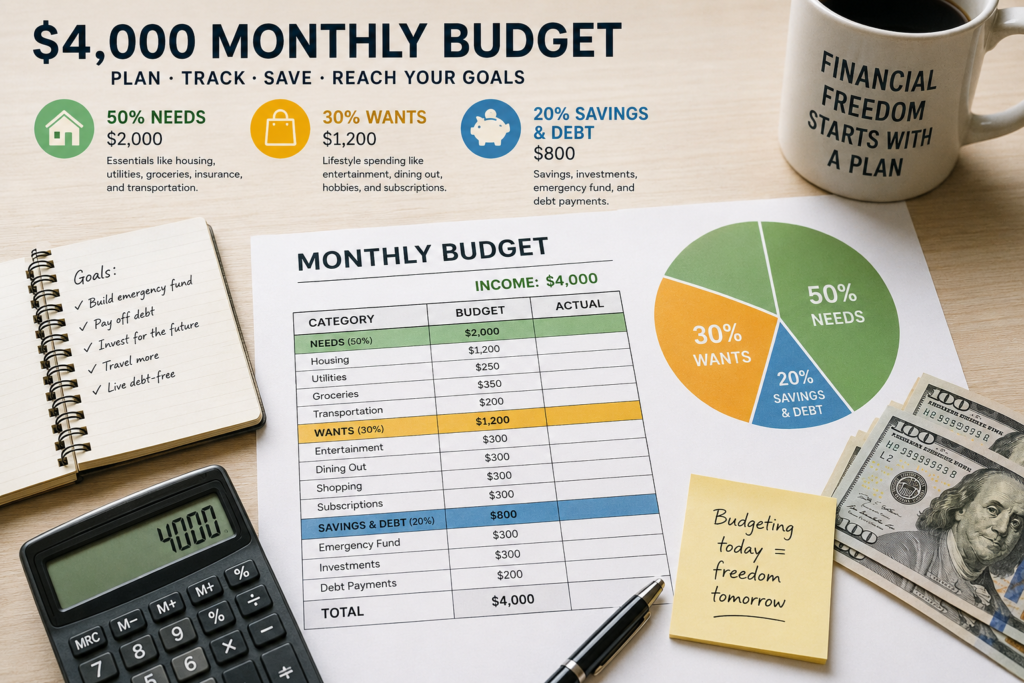
One of the most effective and easy-to-implement methods is the 50/30/20 rule, which divides
income into three categories:
50% for basic needs ($2,000): rent or mortgage, utilities, food, transportation, and
insurance.
30% for personal wants ($1,200): entertainment, dining out, non-essential purchases, and
leisure activities.
20% for savings and debt ($800): emergency fund, investments, and paying down debt
beyond the minimum.
This split isn’t a rigid rule but a reference framework. If you live in a city with high rent, you may
need to adjust the percentages, allocating more to the first group and reducing the second. It’s
worth noting that, according to recent data, nearly half of those who budget (49%) do so specifically
to increase their overall savings, a share that rises to over 60% among young adults.
- Prioritize your emergency fund
Before thinking about investments or major discretionary spending, it’s essential to build a financial
cushion. Ideally, you should have the equivalent of three to six months of basic expenses saved in
an easily accessible account. With a $4,000 income, setting aside between $200 and $400 a month
for this fund will let you reach that goal within a reasonable timeframe, providing peace of mind in
the face of unexpected events like job loss, medical emergencies, or urgent repairs. This priority
makes even more sense considering the country’s average savings rate is only around 3.8%, far
from offering a real cushion in an emergency. - Control your fixed expenses
Fixed expenses tend to make up the largest portion of the budget and, paradoxically, the part that
gets reviewed the least. It’s worth doing a periodic audit of these commitments:
Housing: shouldn’t exceed 30% of net income, which is around $1,200 in this case.
Utilities (electricity, water, internet, gas): comparing rates and negotiating plans can
generate significant savings.
Transportation: evaluate whether public transit, carpooling, or owning a car makes more
sense, factoring in gas, insurance, and maintenance.
Insurance: review health, auto, or home policies annually to make sure they’re still
competitive.
Cutting these expenses, even by small percentages, frees up money that can be redirected toward
savings or more important financial goals. - Be strategic with variable expenses
Food, entertainment, and personal purchases are the areas with the most room to maneuver. Some
useful strategies include:
Planning weekly meals to reduce food waste and avoid unnecessary delivery orders.
Setting a monthly limit for entertainment and outings, and sticking to it with discipline.
Using expense-tracking apps that send alerts when you’re approaching the limit for each
category.
Applying the 24-hour rule before making unplanned purchases over $50, to avoid impulsive
decisions.
This kind of adjustment becomes especially relevant during high-spending seasons. For example,
nearly a quarter of parents turn to credit cards or “buy now, pay later” services to cover seasonal
expenses like back-to-school shopping, a sign that planning ahead can help avoid unnecessary debt. - Automate savings and debt payments
One of the most common mistakes is saving “whatever’s left over” at the end of the month, when in
most cases nothing is left over. The solution is to flip the order: save first, spend second. Setting up
automatic transfers to a savings account on the same day you get paid turns saving into a non-
negotiable habit, rather than a decision that depends on willpower.
If you have high-interest debt, like credit cards, it’s worth allocating an additional portion of the
budget to pay it off as quickly as possible. The “snowball” method (paying off the smallest debts
first to build momentum) or the “avalanche” method (tackling the highest-interest debts first) are
two proven strategies for getting out of debt in an organized way.
- Review and adjust your budget monthly
A budget isn’t a static document; it should evolve as circumstances change. Spending 15 or 20
minutes at the end of each month reviewing which categories went over and which had room to
spare allows for realistic adjustments instead of setting impossible goals. This review is also a
chance to celebrate wins, like hitting a savings goal or cutting an unnecessary expense. - Think long term
Managing $4,000 a month isn’t just about surviving until the next paycheck—it’s about building a
solid financial foundation for the future. Once basic needs and the emergency fund are covered, it’s
worth considering:
Contributions to a retirement plan or investment account.
Ongoing financial education to make better decisions.
Specific goals, like buying a home, starting a business, or traveling.
Conclusion
Effectively managing a $4,000 monthly budget doesn’t come down to luck, but to discipline,
planning, and constant review. The data is clear: nearly half of U.S. households still don’t budget,
and the national average savings rate remains far below what’s recommended. Applying a clear
structure like the 50/30/20 rule, automating savings, controlling fixed and variable expenses, and
keeping a long-term outlook are the pillars that turn a fixed income into real financial stability and
growth. The key is consistency: small, sustained adjustments over time produce far more
meaningful results than a single month of “tightening the belt” followed by abandoning the plan the
next.
Data sources: YouGov (U.S. budgeting and spending trends 2026), Trading Economics (U.S. personal savings rate), U.S.
Bureau of Labor Statistics, Deloitte and National Retail Federation (2026 back-to-school spending), The Motley Fool.