
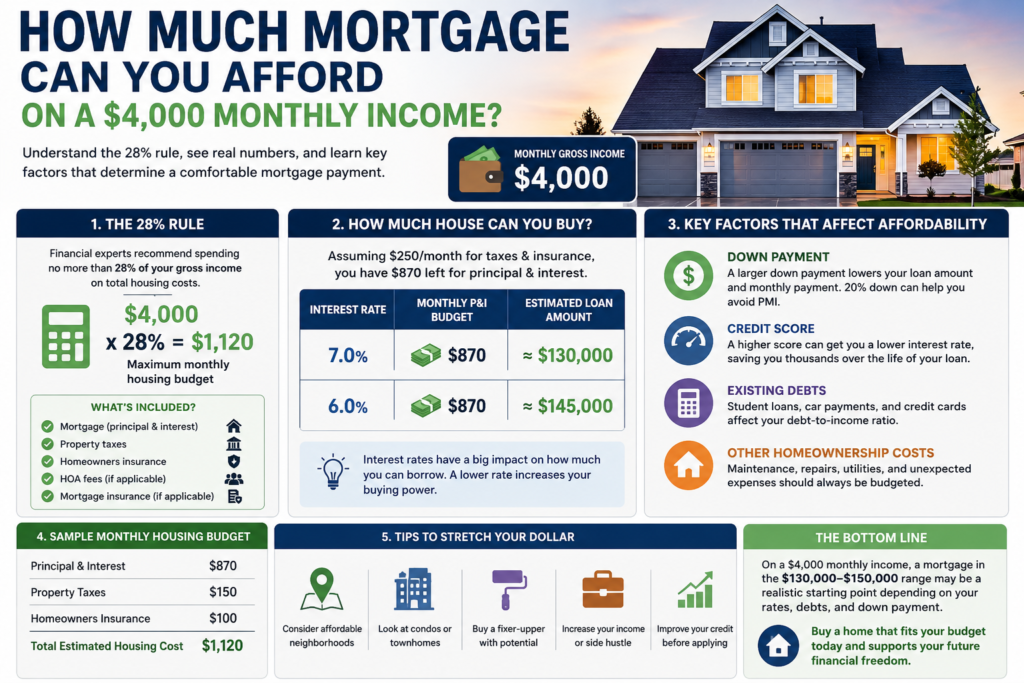
Buying a home on a $4,000 monthly income is possible, but determining how much mortgage you can afford requires more than looking at the maximum amount a lender is willing to approve.
A bank may approve you for a mortgage that appears attractive on paper, but that does not necessarily mean the payment fits comfortably into your everyday budget. Your income must also cover food, transportation, utilities, insurance, savings, debt payments, emergencies, and other financial priorities.
So, how much mortgage can you afford on a $4,000 monthly income?
For many buyers, a reasonable starting point may be a mortgage in the $130,000 to $150,000 range, depending on the interest rate, down payment, property taxes, homeowners insurance, credit score, and existing debts.
Let’s examine how to calculate a realistic mortgage budget.
Understanding the 28% Mortgage Rule
One of the most common guidelines for determining housing affordability is the 28% rule.
The guideline suggests keeping your total monthly housing expenses at or below approximately 28% of your gross monthly income.
If you earn $4,000 per month:
$4,000 × 28% = $1,120
This means approximately $1,120 could represent your maximum monthly housing budget under this guideline.
However, this amount does not refer exclusively to your mortgage principal and interest. Your total housing payment may also include:
- Mortgage principal
- Mortgage interest
- Property taxes
- Homeowners insurance
- HOA fees
- Mortgage insurance, if applicable
Therefore, if property taxes and homeowners insurance cost approximately $250 per month, you would have around $870 available for principal and interest.
This distinction is extremely important when calculating how much house you can actually afford.
How Much House Can You Buy on $4,000 a Month?
Your mortgage affordability depends heavily on the interest rate.
For example, suppose you qualify for a 30-year fixed mortgage at approximately 7%.
If you have about $870 available each month for principal and interest, your potential loan amount could be around $130,000, depending on the exact loan terms.
If the interest rate falls to 6%, the same monthly payment could potentially support a loan closer to $145,000.
These numbers are examples rather than guarantees. Actual mortgage affordability will vary based on your credit score, debt-to-income ratio, loan program, property taxes, insurance, down payment, and other factors.
The important lesson is that interest rates can significantly affect your purchasing power.
A lower mortgage rate can allow the same monthly payment to support a larger loan, while a higher rate can reduce the amount you can comfortably borrow.
Why the Bank’s Maximum Is Not Always Your Maximum
One of the biggest mistakes homebuyers can make is assuming that the amount a lender approves is automatically affordable.
Lenders evaluate your financial situation using specific qualification criteria. They consider factors such as income, credit history, existing debts, and debt-to-income ratios.
However, your personal budget includes many expenses that may not receive the same attention during the approval process.
For example, you may need to save for retirement, support children, maintain a vehicle, build an emergency fund, or pay for education.
A mortgage that technically qualifies you for a $200,000 or $250,000 home could still leave your household with very little financial flexibility.
The goal should not be to purchase the most expensive property you qualify for.
The goal should be to purchase a home that you can afford comfortably and sustainably.
How Your Down Payment Changes Mortgage Affordability
Your down payment can have a major impact on your mortgage payment.
Consider a $150,000 home.
With a 20% down payment, you would contribute $30,000 and borrow approximately $120,000 before considering closing costs and other expenses.
A smaller down payment could allow you to purchase the home sooner, but you would generally borrow more money.
Depending on the loan type, putting less than 20% down may also result in private mortgage insurance (PMI).
PMI can increase your monthly housing costs, which is particularly important when you are working with a $4,000 monthly income.
However, saving 20% is not always necessary. Some mortgage programs allow qualified buyers to purchase homes with substantially smaller down payments.
The right choice depends on your financial circumstances, savings, credit profile, and long-term goals.
Don’t Forget the Hidden Costs of Homeownership
Your mortgage payment is only one part of the cost of owning a home.
Homeowners also need to budget for expenses such as:
- Property taxes
- Homeowners insurance
- Maintenance
- Repairs
- Utilities
- HOA fees
- Appliances
- Landscaping
- Major replacements
A broken water heater, damaged roof, or failed air-conditioning system can create a significant unexpected expense.
For this reason, having an emergency fund is especially important before purchasing a home.
If your calculated maximum housing budget is $1,120, you may want to target a lower monthly payment so that you have room for unexpected expenses and continued savings.
Financial flexibility is often more valuable than purchasing additional square footage.
Your Credit Score Can Affect Your Mortgage
Your credit score is another important factor when determining how much mortgage you can afford on a $4,000 income.
A stronger credit profile may help you qualify for more favorable mortgage terms and potentially a lower interest rate.
Before applying for a mortgage, consider reviewing your credit reports, paying down revolving debt, making payments on time, and avoiding unnecessary new credit applications.
Even a relatively small change in your interest rate can have a substantial effect on the total amount of interest you pay over the life of a 30-year mortgage.
Improving your credit before buying a home can therefore be a valuable part of your overall mortgage strategy.
Ways to Increase Your Home-Buying Power
If homes within your target price range are difficult to find, there are several strategies you can consider.
You could look at:
- Smaller homes
- Townhouses
- Condominiums
- Less expensive neighborhoods
- Properties requiring cosmetic improvements
- Areas with lower property taxes
Increasing your income can also improve your financial position.
An additional $500 per month from overtime, freelance work, a side business, or a salary increase could help you save for a larger down payment and potentially improve your mortgage qualification.
However, additional income should ideally be combined with responsible budgeting rather than used as an excuse to take on excessive debt.
What Is a Comfortable Mortgage Payment on $4,000 a Month?
A reasonable starting point is to keep total housing expenses near or below the 28% guideline, which equals approximately $1,120 per month on a $4,000 gross monthly income.
But your personal target may need to be lower if you have significant student loans, credit card balances, car payments, childcare expenses, or other financial obligations.
For some households, keeping housing costs closer to $900–$1,000 per month may provide substantially more financial flexibility.
The best mortgage is not necessarily the largest mortgage you can obtain. It is the mortgage that allows you to own a home while continuing to save, invest, manage emergencies, and enjoy your lifestyle.
Final Thoughts: How Much Mortgage Can You Afford on $4,000 a Month?
So, how much mortgage can you afford on a $4,000 monthly income?
Under reasonable assumptions, a mortgage around $130,000 to $150,000 may be a conservative starting point for some buyers. However, the appropriate amount will vary significantly depending on your interest rate, down payment, credit score, taxes, insurance, existing debt, and other expenses.
Before purchasing a home, calculate the complete monthly cost—not just the advertised mortgage payment.
A financially sustainable home should give you stability rather than constant financial pressure.
The ultimate goal is not to buy the biggest house a lender will approve. It is to buy a home you can comfortably afford while continuing to build a stronger financial future.