
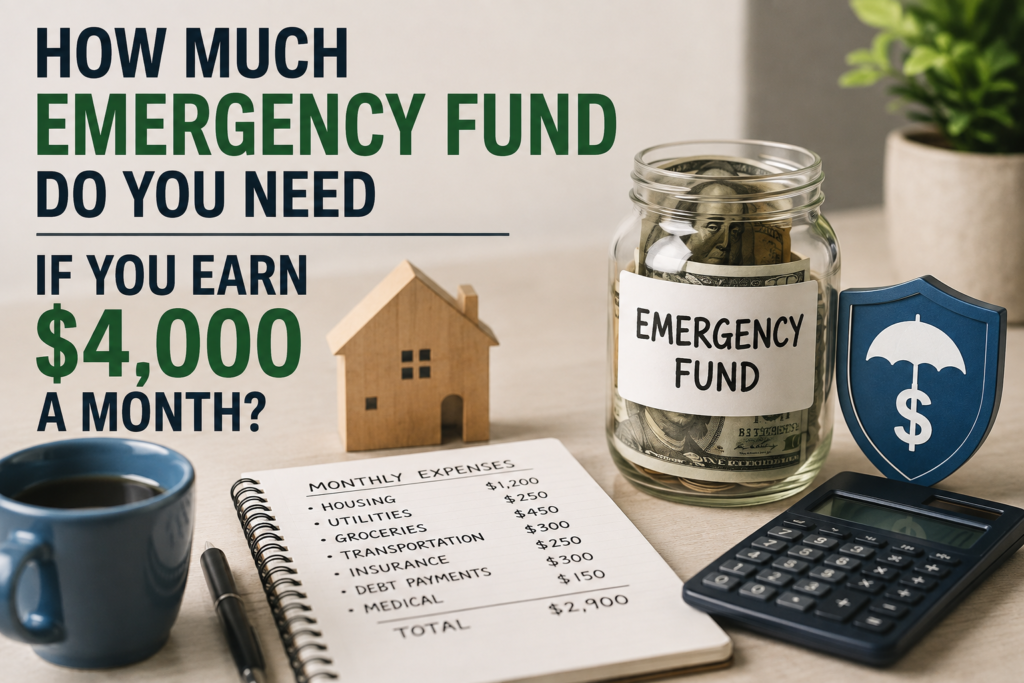
Quick Takeaway: If you earn $4,000 a month, a standard rule of thumb suggests an emergency fund between $8,000 and $18,000. However, the right amount depends entirely on your essential expenses, not your gross salary.
If you earn $4,000 a month, you may feel financially secure—especially if your income is stable and your bills are under control. But income alone does not determine how much cash you should keep in reserve.
What truly matters is how much you spend, how secure your job is, who depends on you, and how quickly you could replace your income if something went wrong.
While standard advice suggests saving 3 to 6 months of living expenses, simply multiplying your monthly salary ($4,000) by three or six can be misleading. Your emergency fund should always be based on necessary monthly expenses, not your gross or net salary.
1. Start With Your Essential Monthly Expenses
Suppose you take home $4,000 per month. Your standard lifestyle might absorb every dollar, but your actual survival budget is likely much lower. Consider this breakdown of essential monthly costs:
- Rent or mortgage: $1,200
- Utilities: $250
- Groceries: $450
- Transportation: $300
- Insurance: $250
- Minimum debt payments: $300
- Essential medical/family expenses: $150
- Total Essential Expenses: $2,900 per month
If you lost your job tomorrow, you would immediately cut non-essential spending like dining out, entertainment, subscriptions, and shopping. Therefore, saving six months of your normal lifestyle expenses ($24,000) requires far more cash than you actually need to survive.
Using $2,900 as your baseline:
- 3 Months: ~$8,700
- 6 Months: ~$17,400
This approach gives you a realistic, stress-free target compared to arbitrary salary multipliers.
2. Is a 3-Month Emergency Fund Enough?
A three-month reserve is a reasonable starting goal if your financial foundation is rock solid. You might consider three months sufficient if you have:
- High job security and specialized skills.
- Strong health insurance and low consumer debt.
- No dependents relying solely on your income.
- A dual-income household where a partner can bridge the gap.
In these conditions, an emergency fund of $8,000 to $10,000 provides solid baseline protection.
The Reality Check: Job loss is rarely an isolated event. You might face car repairs, medical deductibles, or urgent home repairs at the exact moment your income stops. Because of this, three months should be viewed as a minimum milestone, not a universal destination.
3. When Does a 6-Month Fund Make More Sense?
A six-month safety net ($17,400 based on our $2,900 expense model) provides a significantly larger cushion against uncertainty. You should lean toward a 6-month (or larger) fund if you:
- Are self-employed or work on commission or freelance contracts.
- Operate in a volatile industry or have a single-income household.
- Have children, elderly parents, or other dependents.
- Carry significant financial obligations or debt.
For freelancers whose monthly income fluctuates wildly (e.g., $4,000 one month, $2,500 the next), a larger cash buffer smooths out the income valleys.
4. What If You Are the Sole Breadwinner?
Your emergency fund must reflect your family responsibilities. If your $4,000 monthly paycheck supports a spouse and children, losing that income impacts everyone simultaneously.
If your household essential expenses rise to $3,500, a six-month target becomes $21,000. While that figure sounds intimidating, view it as insurance against financial disruption. You aren’t saving $21,000 because you expect disaster; you are buying your family time to adapt if the unexpected strikes.
5. Don’t Confuse an Emergency Fund With Investments
An emergency fund must prioritize liquidity and stability, not maximum returns. Keep this money in a high-yield savings account (HYSA) or low-risk, cash-equivalent vehicle where it is instantly accessible without penalty.
- Putting your emergency fund into stocks might yield higher long-term returns, but it introduces massive risk: the market could crash precisely when you need the cash.
- Losing your job during a recession only to discover your $15,000 emergency portfolio has shrunk to $11,000 forces you to sell investments at a severe loss.
The purpose of this fund isn’t to make you rich—it’s to keep a temporary crisis from turning into a permanent setback.
Summary: Your Practical Savings Roadmap
If you earn $4,000 a month, use this phased progression to build your financial safety net without feeling overwhelmed:
- Starter Buffer: $1,000 – $2,000 (Covers minor unexpected car or medical bills).
- Three-Month Target: ~$8,700 (Based on $2,900 in essential monthly expenses).
- Six-Month Target: ~$17,400 (Ideal for single earners, families, or variable incomes).
- Extended Target (6–12 Months): For specialized careers or high-risk industries.
Final Thoughts
Your ideal emergency fund is the exact amount that allows you to handle a major crisis without resorting to high-interest credit cards, raiding retirement accounts, or borrowing from family.
At $4,000 a month, hitting a $10,000 balance is a massive milestone. Reaching $15,000 to $18,000 gives you true financial breathing room. Remember: Don’t build your emergency fund around your salary; build it around the life that salary supports.
Suggested SEO Metadata (for WordPress / SureRank)
- Focus Keyword: emergency fund for 4000 a month / how much emergency fund do I need
- Meta Title: How Much Emergency Fund Do You Need on $4,000 a Month?
- Meta Description: Earn $4,000 a month? Discover how much you really need in your emergency fund based on essential expenses, job stability, and family responsibilities.