Buying a home is one of the most significant financial milestones you will ever undertake. If you earn $4,000 per month, you might wonder whether homeownership is a realistic goal or out of reach.
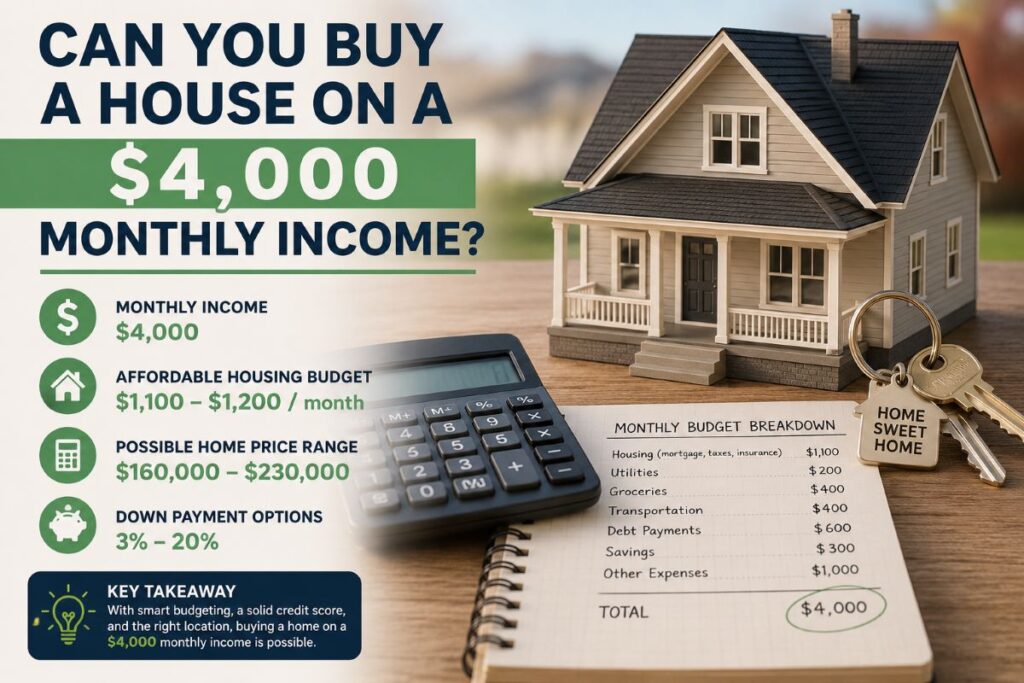
The good news: Yes, purchasing a home on a $4,000 monthly income is achievable. However, your exact purchasing power depends on several key variables, including your existing debt, credit score, savings, local real estate market, and prevailing mortgage interest rates.
1. Understanding Your Monthly Income
A monthly gross income of $4,000 translates to approximately $48,000 annually before taxes. While this income tier may not qualify you for luxury real estate, it provides strong entry into affordable housing markets and first-time homebuyer programs.
Mortgage underwriters evaluate your overall financial picture beyond your base salary. Key factors include:
- Debt-to-Income (DTI) Ratio: The percentage of pre-tax income dedicated to monthly debt payments.
- Credit Score & History: Determines your interest rate and loan eligibility.
- Down Payment & Liquid Reserves: Influences loan terms and initial equity.
- Employment Stability: Lenders typically look for a steady two-year work history.
2. The Debt-to-Income (DTI) Benchmark
Your Debt-to-Income (DTI) ratio is a primary metric used by lenders to assess risk. DTI represents the percentage of your gross monthly income allocated toward recurring debt obligations, such as credit cards, auto loans, student debt, and your future housing payment.
Most conventional guidelines recommend keeping your total DTI below 43%, though specific loan programs (like FHA) may allow higher thresholds under certain conditions.
| Financial Profile | Monthly Income | Max Total Monthly Debt (43% DTI Limit) |
|---|---|---|
| Gross Monthly | $4,000 | $1,720 |
Key Takeaway: If you have zero existing debt, your entire $1,720 cap can theoretically go toward housing. However, if you already pay $500 monthly for a car loan and student debt, your maximum allowable mortgage payment drops to $1,220.
3. How Much House Can You Afford?
Financial planning standard practices advise adhering to the 28/36 Rule: spend no more than 28% of gross income on total housing expenses, and no more than 36% on total debt obligations.
Recommended Housing Allowance (28%–30% Standard)
- 28% of Gross Income: $1,120 / month
- 30% of Gross Income: $1,200 / month
Your total housing budget must cover PITI:
- Principal (loan balance payoff)
- Interest (lender fee)
- Taxes (property taxes)
- Insurance (homeowners insurance & PMI, if applicable)
Depending on local property tax rates and current mortgage interest rates, a monthly housing budget between $1,100 and $1,200 generally supports a home purchase price between $160,000 and $230,000.
4. The Impact of Your Down Payment
Your down payment directly affects your monthly payment and overall borrowing costs. While a 20% down payment eliminates Private Mortgage Insurance (PMI), many first-time buyers leverage low-down-payment options.
Common Down Payment Scenarios ($200,000 Purchase Price)
- 3.5% (FHA Minimum): $7,000
- 5% (Conventional Minimum): $10,000
- 10% (Moderate Equity): $20,000
- 20% (Standard – No PMI): $40,000
5. Credit Score Tiers and Interest Rates
Your credit score directly dictates the interest rate you are offered. Lower rates result in lower monthly payments, significantly expanding your home-buying budget.
- 760+ (Excellent): Secures the lowest market interest rates.
- 700–759 (Good): Qualifies for competitive rates and favorable terms.
- 660–699 (Fair): Standard qualification; slightly higher interest rates.
- Below 660 (Subprime): Higher borrowing costs; may require specialized loan programs (e.g., FHA).
6. Location and Ongoing Ownership Costs
Geographic Variability
Where you shop determines what $4,000/month can buy:
- Midwestern & Rural Markets: Frequently offer detached single-family homes under $200,000.
- Major Metropolitan & Coastal Areas: Median prices often exceed $500,000, making condo ownership or surrounding suburban markets more practical options.
Beyond the Mortgage Payment
Always factor hidden and recurring costs into your budget:
- Property taxes and homeowners insurance
- Homeowners Association (HOA) fees
- Utilities (water, gas, electric, trash)
- Routine maintenance and emergency repairs (budget 1%–2% of the home’s value annually)
Strategic Action Steps for Homebuyers
To maximize purchasing power on a $4,000 monthly income:
- Reduce Existing Liabilities: Pay down credit card balances and short-term debt to optimize your DTI.
- Elevate Your Credit Profile: Pay all bills on time and keep credit utilization below 30%.
- Build Cash Reserves: Save for both the down payment and an emergency fund (3–6 months of expenses).
- Explore First-Time Buyer Assistance: Research local and state grants offering down payment and closing cost assistance.
- Obtain Mortgage Pre-Approval: Secure a formal pre-approval letter before touring homes to establish a firm budget.
Final Verdict
Buying a home on a $4,000 monthly income is entirely realistic with disciplined financial planning. By managing existing debts, maintaining strong credit, and exploring affordable regional housing markets, homeownership can serve as a secure foundation for building long-term wealth.
Strategic Next Steps
To give you a clearer picture of your exact purchasing power, we can take a closer look at a few details:
- Which region or state are you planning to buy in? (Tax rates vary significantly by area.)
- How much existing monthly debt (car payments, credit cards, loans) do you currently hold?
- What estimated down payment amount do you have saved?